The pen is on the wrong side of the desk again, next to a half-closed drawer, and the phone is already back in your pocket. You can still hear the other person’s voice saying Thursday, but the word has started to blur at the edges. What else was attached to it?
The most reliable moment to save a phone call is the last thirty seconds of it. Before you hang up, say the key detail back to the other person in your own words: the date, the name, the next step. If they correct you, write down the corrected version. If they confirm it, write down what was agreed and whose job it is. That single habit catches more lost details than any technique applied after the fact.
The problem is that most of us treat the call as finished when the talking stops. We hang up, set the phone down, and walk straight into the next thing, carrying a vague sense of what was said. The detail felt solid while it was still in the air. Ten minutes later it is a shape without edges, and by evening the action it belonged to has dissolved entirely. Research on conversation memory suggests that even active participants lose specifics quickly, and that producing information yourself, saying it aloud, helps it stay.
What follows is a way to decide when to write during a call, when to wait until it ends, and how to handle the details that change or get corrected halfway through. The goal is not a perfect transcript. It is a note good enough to act on.
Write during the call or right after it
The note method is the reliable baseline: short, written during the call, verified before goodbye. It asks very little of memory because it moves the detail out of your head while the call is still happening. The tradeoff is attention. Writing while listening splits the same working capacity you need to follow the other person, and the result can be a half-written note about a half-heard instruction.
The research on spoken instructions points to working memory as a limiting factor, which is a careful way of saying you can hold only so much while also listening. So the note has to stay skeletal. Names, numbers, dates, the one verb that matters. If you find yourself writing sentences, you have probably stopped listening. A note that costs you the rest of the call is not a system, it is a leak with stationery.
The alternative is to defer everything to the seconds after the call, when your attention is free again. That can work for simple calls with one or two outcomes. It fails quietly on calls that carry several details, because without a written anchor there is nothing to check your recall against. The choice is not between good memory and bad memory. It is between a small attention cost now and a larger reconstruction cost later.
The last thirty seconds of the call
Picture a call where the other person is still explaining the next step. If the detail is still arriving, do not hang up on your own uncertainty. Say the important piece back in your own words, even if it feels slightly formal. Something like: so you need the form by Thursday, and it goes to the Leeds office, not the York one. Their correction or confirmation is the single most valuable thing the call can produce, and it disappears the moment you ring off. This is not awkwardness. It is the one check that costs nothing and catches almost everything.
Before you hang up
- Say the key detail back in your own words.
- Write down the corrected version if they correct you.
- Write down what was agreed and whose job it is.
- Read back dates and reference numbers on the spot.
Now picture the call already finished and the room gone quiet. If the call has just ended, write the action note before you do anything else, in the same sixty seconds, even if your handwriting is terrible. The shape matters more than the neatness: the action, the owner, the date or deadline, and any number or name you will need. One line is often enough. The failure mode here is not bad handwriting or a bad notebook. It is the small internal decision to do it in a minute, because the minute fills with the kettle, the inbox, the next thing, and the detail you meant to keep is already fading.
If the same blank keeps turning up after different calls, with the next step missing again in a new setting, it is worth pausing to ask what those moments might have in common beyond this one note.
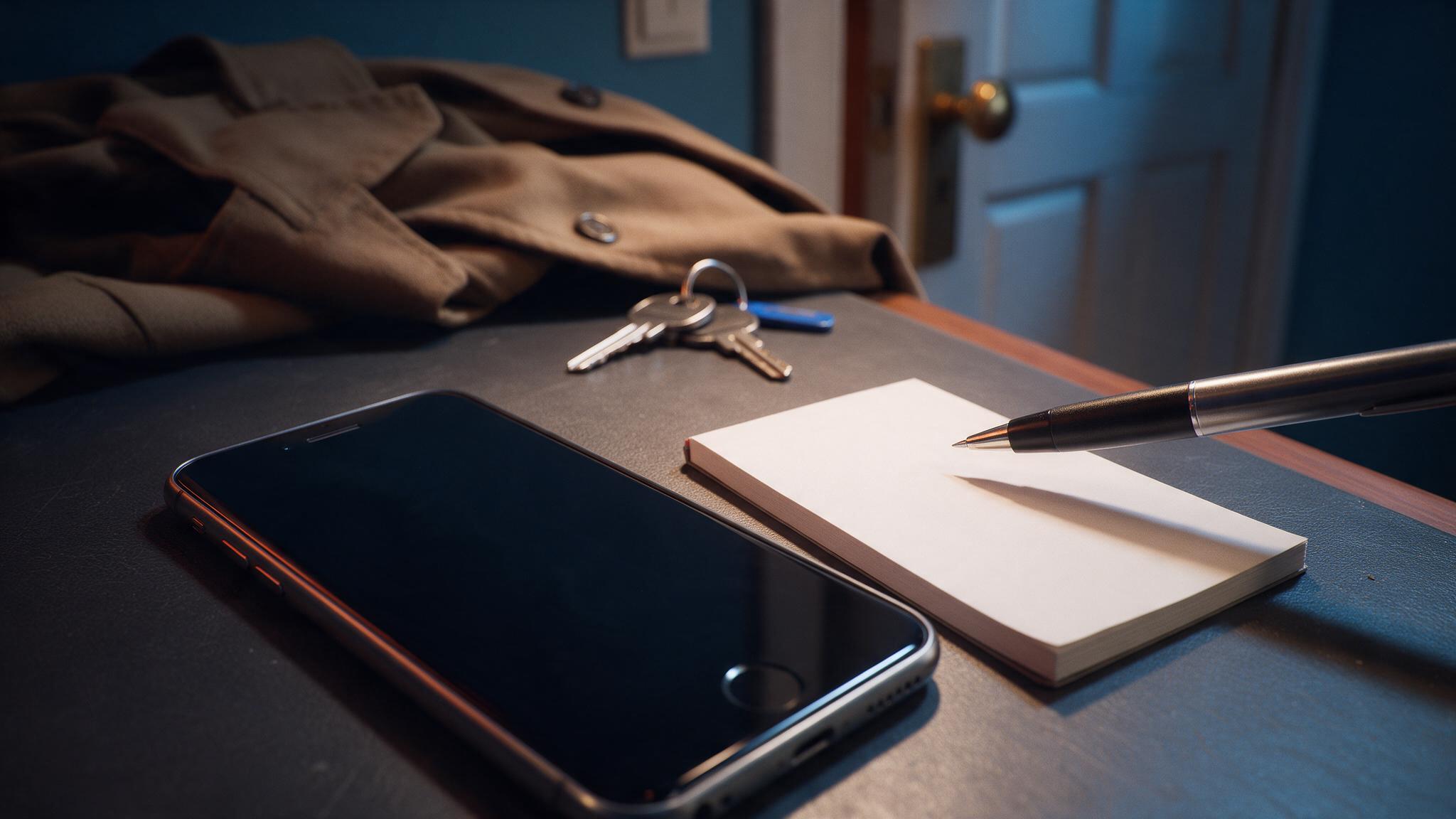 The last thirty secondsThe detail you lost before you hung upWatch the video to see the one habit that catches what slips away the moment a call ends.
When you are ready to look at the wider pattern behind recurring memory slips, watch the full video presenting an approach to improving memory and consider its explanation for yourself.
When the details change mid-call
Some calls do not stay put. A date moves, a name is corrected, the address changes halfway through a sentence. The instinct is to keep hold of the final version and let the earlier one fall away, but the ear does not always cooperate. If you are writing during a call like this, the correction has to overwrite the note, not sit beside it. Strike the old detail through or replace it entirely, because two versions on paper will later look like two equally valid facts.
When the detail changes
- If a date moves, strike the old one through entirely.
- If a correction arrives late, repeat only that piece back.
- If you are holding your own reply, let it wait a beat.
- If the call ends without confirmation, send a short message the same day.
When you are holding a reply or a question of your own while the other person corrects themselves, something has to give. It is similar to the problem of keeping your response in mind while someone finishes speaking, except here the thing at risk is not your point but their fact. Let your own thought wait a beat. Catch the corrected version first. Your reply can survive a pause; a wrong number rarely survives the call.
If the correction arrives late, near the end of the call, treat it as the detail that defines the note. Repeat that one piece back rather than the whole summary. People often try to re-verify everything in the last moments and end up verifying nothing. The corrected item is usually the one that matters most, precisely because it was easy to get wrong the first time.
Confirming whose next action it is
The most durable misunderstanding after a call is not a wrong number. It is a wrong assumption about who is doing what. Both people hang up warm and agreeable, each quietly certain the other is handling the next step, and a week later nothing has moved. The note habit does not fix this on its own, because you can write down a perfectly accurate detail and still carry home a completely wrong owner for the task.
The remedy is a plain closing question, asked without embarrassment: just so I have it straight, you are sending the invoice and I am calling the supplier, is that right? This is a different skill from recalling what was agreed in a conversation later, because it removes the need for that recall altogether. It also differs from holding spoken directions long enough to act on them, where the steps are yours alone. Shared actions need shared confirmation.
If the call ends without that confirmation and you realise it later, the correction is still available. A short message the same day works well: I have you down for the contract and me for the booking, shout if I have it backwards. It feels administrative. It is. That is the point. The small awkwardness of checking is much cheaper than the large awkwardness of discovering, three weeks on, that the task had no owner at all.
A simple system that survives busy days
A workable system for calls is smaller than most people expect. One notebook or one digital note, always in the same place, used every time, matters more than any format. The CUH patient guidance on managing memory problems describes a memory centre with a notepad and diary within reach of the phone, and the principle transfers: the tool should be where the call happens, not where you wish it were. A perfect template in another room loses to a scrap of paper on the desk.
The four-part note
- What was decided
- Who owns it
- When it happens
- Any number or name that would be expensive to lose
The note itself needs only four parts: what was decided, who owns it, when it happens, and any number or name that would be expensive to lose. Dates and reference numbers deserve to be read back on the spot, because they are the details most likely to be transcribed wrong and least likely to be recoverable from context. Everything else can stay rough. The note is a tool for action, not a record for posterity.
There is also a boundary worth naming. An occasional lost detail after a busy call is ordinary. NHS guidance suggests seeing a GP if memory problems keep affecting day-to-day life, and MedlinePlus notes that forgetting how to use familiar tools or find your way home warrants professional attention. A notebook handles the first kind. The second kind deserves a conversation with a doctor, not a better pen. If you want a wider frame for the conversational side of this, the ways to keep and recover a conversation’s thread sit alongside what this page covers.
Start with the next call. Keep the pen where the phone is. Verify one detail before goodbye. That is enough to change what survives the call.
The slip that leaves a blank in your notebook may be the small version of a pattern that keeps returning, and this page has only traced its outline. Watch the full video to see the wider shape it takes.