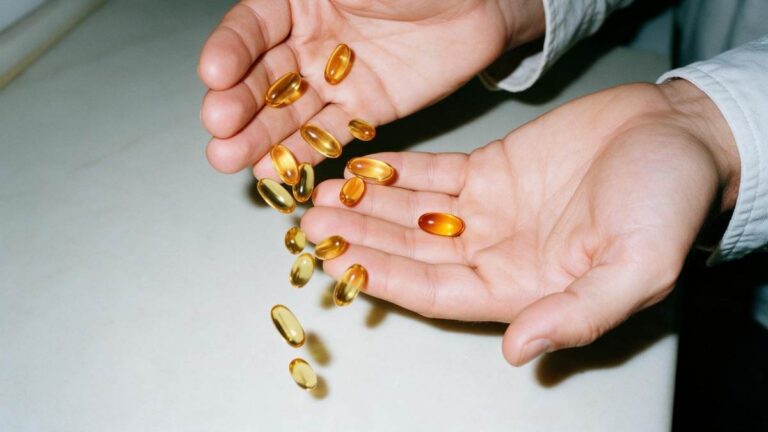
Phosphatidylserine is what you are reading on the bottle in your hand, standing in the kitchen with the under-cabinet light on and the mug you forgot about going cold on the counter. Earlier that day a word left you in the middle of a sentence, and you covered it with a gesture and nodded as if the sentence had finished. You typed the supplement name next to the word cortisol and landed here, wanting one straight answer before the bottle gets put away. Phosphatidylserine is sold on the claim that it lowers cortisol, good human trials on that claim are scarce, and published guidance gives no dose. So what this page can honestly do is describe the shape of that evidence, name what a useful study would have to show, and follow the claim to the place you actually noticed it: the blanks.
The state of the phosphatidylserine and cortisol research
Cortisol is the hormone people mean when they say stress hormone, and the claim under discussion is a chain with three links: stress pushes the level up, phosphatidylserine blunts that push, and the ordinary consequences of a stressed day ease off. Each link needs its own measurement. Good human trials on this chain are scarce, and published guidance gives no dose, so the confident instructions circulating online are not carrying a settled finding behind them.
Scarcity is not the same as absence. It means nobody can honestly tell you how much, how often, or for how long, and that a page offering a schedule is outrunning the evidence. We keep coming back to this with supplements: the market moves faster than the trials, and the space left by a missing trial fills up with confident strangers.
The useful move is to read the claim as a hypothesis rather than a result, and to ask what would have to be measured before anyone could repeat it with a straight face. That question is where the rest of this page goes.
Your turn comes at the status meeting and the word for the metric is simply gone, so you point at the spreadsheet and say the number instead. Afterward you start writing every name into your notes before the call, you read your summary from the page rather than from your head, and you stop putting your hand up for the opening slide. The presentation still goes fine. What quietly goes is the part where you spoke without a script, and nobody in the room notices the trade you made.
What would a useful study have to measure?
Four columns hold a cortisol claim upright: setting, dose, cortisol measure, result. A reader can carry those in their head while reading, and a study that cannot fill all four has not answered the question it was asked.
 Does phosphatidylserine really lower cortisol?What would a real study have to show?Watch the video that follows the claim column by column
Four columns a cortisol claim needs
| Setting | Dose | Cortisol measure | Result |
|---|---|---|---|
| Where the stressor was applied | Given and the period given over | Chosen rather than implied | Against a placebo |
| Stressor named rather than implied | Given and the period given over | Chosen rather than implied | Against a placebo |
| An ordinary week instead of an afternoon | Given and the period given over | Chosen rather than implied | Against a placebo |
Exercise stress study: the setting where the stressor was applied, the dose given and the period it was given over, the cortisol measure chosen, and the result against a placebo. Mental stress study: the same four columns, with the stressor named rather than implied. Everyday stress study: the same four columns, held across an ordinary week instead of an afternoon.
The gaps between those columns are where a claim goes soft. A study reporting only that participants felt calmer answers a different question than one that measured cortisol. A single afternoon reading tells you less than a measure that accounts for the hormone’s daily rhythm. Without a placebo arm you cannot separate the capsule from the week the person had, and without a stated dose the result cannot be repeated by anyone, including its authors.
Fill the columns, or say the columns are empty. Anything in between is a summary of a hope.
We kept this page short on purpose, and if you want the slower version of the argument, watch the full video before you close the tab.
Does any of this support a weight-loss claim?
The research under discussion measures a hormone response. It does not measure body weight, and a movement in a stress-hormone reading is not a movement on a scale. Those are two experiments with two different outcomes.
There is no weight-loss evidence to report here. A weight-loss claim would need its own trials, its own measure, its own result, and none of that is what a cortisol study is designed to hand you. A plausible mechanism is not an outcome, and treating one as the other is how a reasonable physiological idea becomes an advertisement.
Why does a stress supplement show up in a memory search?
Because the two arrive together, and the blank is the part you notice. The name at the tip of the tongue, the sentence that stalls, the reason you walked into the room: these show up on days when attention is already spoken for. Stress narrows what gets through, and a narrowed field makes the moment feel like forgetting rather than a moment of divided attention.
Where a claim goes soft
- Myth: participants felt calmer. Fact: that answers a different question than a cortisol measure.
- Myth: one afternoon reading settles it. Fact: it tells less than a measure of the daily rhythm.
- Myth: a plausible mechanism is an outcome. Fact: an outcome needs its own trials and its own result.
The causes of memory trouble are several, never one. Sleep, mood, medicines, alcohol, an overloaded week, attention split all afternoon, and ordinary aging all play a part, and a supplement aimed at a stress response is aimed at one link in that list. Even that link is thinly studied, which is why this page will not tell you what to expect from it.
If a change persists or gets worse, that is worth a doctor’s time, because the causes worth ruling out are not all small. If a change comes on suddenly, with weakness, trouble speaking, confusion, or a severe headache, call 911 rather than waiting for an appointment.
Why does the same blank keep returning once the stressful afternoon is over, and is stress really the link doing the work? Attention, sleep, mood, and an overloaded week all sit in the same neighborhood, and which one is responsible for your particular blank is a question this page deliberately leaves open.
Depression, adrenal conditions, and where this belongs
Phosphatidylserine is not a treatment for depression, and it is not a treatment for adrenal conditions. Low mood that lasts, a flat stretch that does not lift, or exhaustion that colors the whole week belongs with a doctor rather than with a supplement order. Depression can be a serious illness, and a person inside one needs more than a bottle.
That is the environment every claim on this page has to survive. Bring whatever you take to your health care provider, because interactions with medicines are possible and a label is not a complete guide.
For the current state of the evidence on complementary approaches, the National Center for Complementary and Integrative Health and the NIH Office of Dietary Supplements publish plain summaries, and they are a better starting point than a thread. We would rather send you to a page that admits what it does not know.
That is the part no page of this length can settle. When the house is finally quiet, watch the full video and give the question the hour it has been asking for.
Everything on Supplements & food →
▶ Watch the memory video