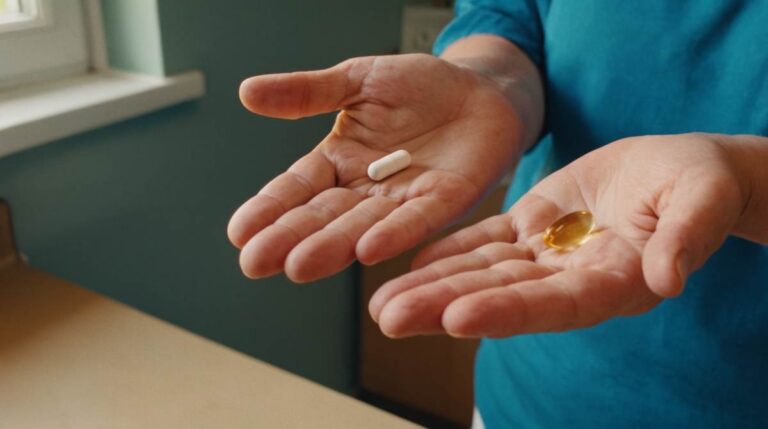
Your medicine list is spread across the bathroom counter, several bottles and one folded note where you wrote down a supplement a friend mentioned. The note says ginkgo, with a question mark beside it. You have no idea whether it belongs beside your blood thinner or far from it, and the small print on the label in your hand will not tell you.
 Which brain supplements after 65?What changed after your sixties?Watch the video and bring these questions to your pharmacist
You are standing in the supplement aisle, holding a bottle with a label that promises sharper thinking, and the print is small enough that you have to tilt it toward the light. The question behind the bottle is not simply which ingredient is best, but what has changed in your body since your sixties and which combinations could cause trouble. The honest answer is that good evidence on the best brain supplements for seniors is limited, and no supplement has been shown to prevent or slow dementia. What you can do is check the safety issues that matter more after sixty-five: vitamin B12 absorption, kidney function, and interactions with medicines you already take. Start with a pharmacist conversation, not a purchase.
What changes after sixty-five
Later life alters how the body handles supplements. Stomach acid often decreases with age, which can reduce the absorption of vitamin B12 from food, though the form in most supplements is less dependent on stomach acid. Kidney function also declines gradually, so ingredients cleared by the kidneys may build up more than they would in a younger adult.
What to ask a pharmacist
| Ingredient | Interactions named in the research | What to ask a pharmacist | Studied in adults over sixty-five |
|---|---|---|---|
| Ginkgo biloba | Anticoagulant drugs such as warfarin, and other medicines | Whether your bleeding risk changes and whether ginkgo is safe with your full medicine list | Yes, the Ginkgo Evaluation of Memory study with people age seventy-five or older |
| Omega-3 supplements | No specific medicine interaction is named in the published research | Whether your diet already provides what you are considering, alongside your medicines and kidney numbers | Includes a review of people aged fifty-five to ninety with mild to moderate Alzheimer’s disease |
The medicines that become more common after sixty-five change the picture further. A supplement that is harmless on its own can interact with a blood thinner, a blood pressure drug, or a medicine for diabetes. The National Center for Complementary and Integrative Health notes that ginkgo may increase the risk of bleeding in people taking anticoagulant drugs such as warfarin.
The National Institute on Aging and the Office of Dietary Supplements both frame supplement decisions as part of overall health, not as a separate category. That means the first question is not what to add, but what your current medicines, kidney numbers, and diet already require.
Ginkgo and the anticoagulant question
Ginkgo biloba is one of the most studied herbs for brain-related claims, and the evidence is clearer on safety than on benefit. The Ginkgo Evaluation of Memory study, funded by the National Center for Complementary and Integrative Health and the National Institute on Aging, randomly assigned more than three thousand people age seventy-five or older with normal cognitive function or mild cognitive impairment to take ginkgo extract or a placebo for a median of six years. There was no difference between the groups in the rates at which participants developed dementia of any type or Alzheimer’s disease.
The safety concern is specific and serious. Ginkgo may increase the risk of bleeding in people taking anticoagulant drugs, and it may also interact with other medicines. The most common side effects of ginkgo leaf extract are dizziness, gastrointestinal symptoms, and headache. For most adults, ginkgo leaf extracts are likely to be safe when taken orally in moderate amounts, but the interaction risk means a pharmacist should review it against your full medicine list before you start.
What the evidence does not show matters as much as what it does. Ginkgo has not been shown to be effective for any of the conditions for which it has been studied, and there is no conclusive evidence that it is helpful for any health condition. A small amount of evidence suggests a benefit for anxiety, PMS, schizophrenia, and vertigo, but the overall evidence is not conclusive.
Omega-3s and the seafood difference
Omega-3 fatty acids, particularly EPA and DHA from fish oil, are often discussed for brain health in later life. The evidence for supplements is weaker than the evidence for eating seafood. The Federal Government’s Dietary Guidelines for Americans 2020–2025 recommends that adults eat eight ounces or more of a variety of seafood per week, and some seafood choices with higher amounts of EPA and DHA should be included.
For cognitive decline, a 2022 review of thirty-three studies suggests that dietary and supplemental omega-3s may have a protective effect against cognitive decline for healthy people without preexisting Alzheimer’s disease or dementia. However, there was no effect on cognition for people already diagnosed with Alzheimer’s disease. A 2018 review of seven studies with 795 participants between the ages of fifty-five and ninety with mild to moderate Alzheimer’s disease found that omega-3 fatty acid supplementation may be beneficial in disease onset, when there is slight impairment of brain function, but the authors said there is not enough evidence to support supplementation for treatment of the disease.
The safety profile of omega-3 supplements is generally mild. Side effects include unpleasant taste, bad breath, bad-smelling sweat, headache, and gastrointestinal symptoms such as heartburn, nausea, and diarrhea.
The interaction table to bring to a pharmacist
Before starting any supplement after sixty-five, the practical step is to check interactions with your current medicines. The following rows summarize what to ask a pharmacist, based on the public health guidance. The column for studied in adults over sixty-five reflects whether the published research includes good human trials specifically in that age group for the ingredient.
Mistakes to catch
- Myth: a supplement is a neutral addition. Fact: after sixty-five it can act like a second drug.
- Myth: a label claim about brain health is evidence. Fact: much of that research is of low quality.
- Myth: ginkgo has been shown to prevent dementia. Fact: no difference in dementia rates over six years.
Ginkgo biloba. Common medicines it can interact with: anticoagulant drugs such as warfarin, and other medicines. What to ask a pharmacist: whether your bleeding risk changes and whether ginkgo is safe with your full medicine list. Studied in adults over sixty-five: yes, in the Ginkgo Evaluation of Memory study with people age seventy-five or older.
Omega-3 supplements. Common medicines it can interact with: the published research does not name a specific medicine interaction for omega-3s. Studied in adults over sixty-five: the evidence includes a 2018 review of people aged fifty-five to ninety with mild to moderate Alzheimer’s disease, but no trial limited to adults over sixty-five without that diagnosis.
The table is short because the published research is short. Good evidence on the best brain supplements for seniors is limited, and the named sources do not provide a longer list of interactions for this age group. A pharmacist can check your specific medicines against a current interaction database, which is more useful than any general list.
The mistake people make
The common mistake is to treat a supplement as a neutral addition, like choosing a different breakfast cereal. After sixty-five, the body’s clearance of substances and the number of prescribed medicines both change, so a supplement can become a second drug rather than a food.
The second mistake is to read a label claim about brain health as evidence. The National Center for Complementary and Integrative Health states that although dietary supplements containing ginkgo have been marketed for brain health, it is uncertain whether they actually influence cognitive performance in healthy people, and much of the research on this topic is of low quality.
The decision that depends on context is whether to take anything at all. If you eat seafood regularly, have normal B12 levels, and take no interacting medicines, the case for a brain supplement is weak. If you have a measured deficiency or a medicine that depletes a nutrient, the decision is different and belongs in a clinical conversation.
There is a wider question under this one, and watch the full video to hear how it is framed.
What you catch once at the pharmacy counter is a single question about ginkgo and warfarin; left unchecked, that same pairing rides along with every dose you take watch the full video and is worth hearing through to the end.
Everything on Supplements & food →
▶ Watch the memory video