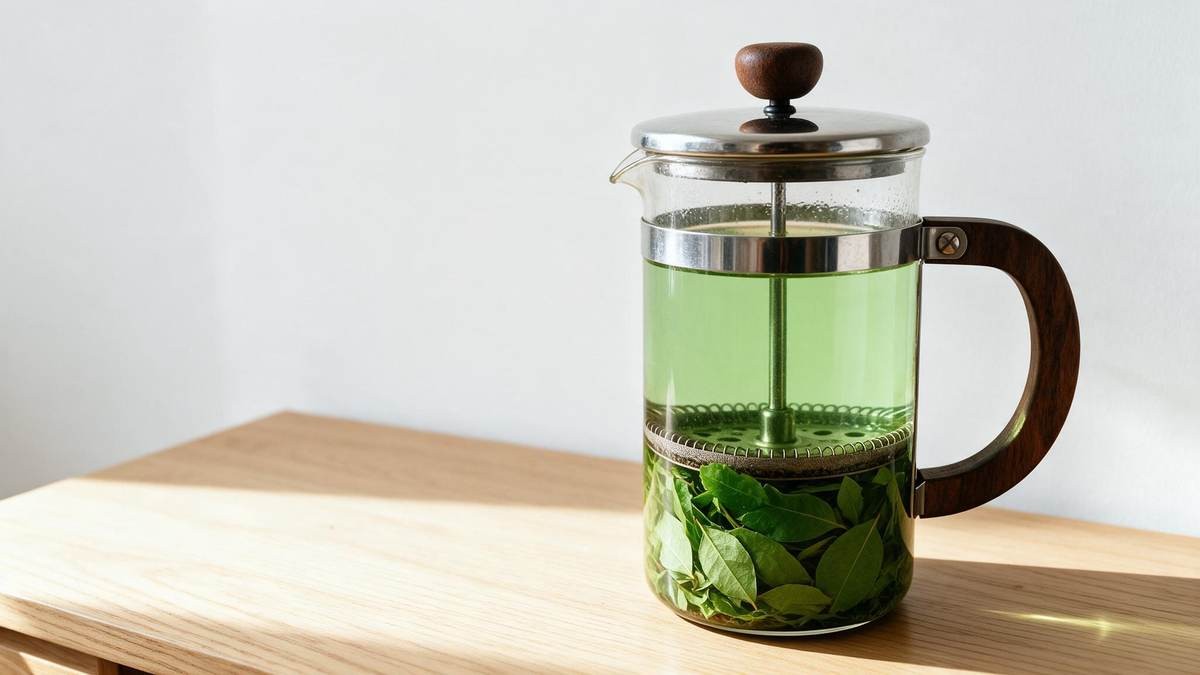
You are halfway down a paragraph you have already read twice, the mug warm against the heel of your hand, a pale ring drying on the desk where you set it down. The words are not hard words. Something keeps pulling at the edge of the room, and each time you look up, the sentence you were holding has gone soft. Then the cup is empty, a few minutes pass, and the same paragraph reads clean, as if it had been waiting for you. Green tea, black tea, and white tea all carry caffeine and L-theanine, and none of them has been shown to improve memory; the outcomes researchers have looked at are alertness and attention in the short run, and good human trials of tea for brain function are scarce. Published guidance gives no dose. So the honest version is narrower than the search results suggest, and narrower than the way you feel a few minutes after the cup empties. What follows is what the evidence can carry, where it stops, and which cautions hold regardless of how the research turns out.
 Focus gone by morning? Read this firstDoes the cup help you rememberWatch the video on what the cup gives your attention and what it leaves open
Where the focus actually comes from
Tea leaves hold two things people point at when they talk about clarity: caffeine, the stimulant most adults already know well enough to schedule around, and L-theanine, an amino acid found in tea leaves that has drawn attention precisely because it travels alongside caffeine in the same cup. Researchers who study the pair are usually asking a short-term question. Does a person feel more alert, and do they hold attention better on a task that lasts minutes? Those are the outcomes that keep appearing, and they are the ones this page will stand behind.
What the cup does not do is store anything. Alertness in the moment and the ability to recall a name three days later are different outcomes measured differently, and the second one has not been established for tea. We keep coming back to that line because the phrasing on most pages blurs it.
It is late afternoon and you pour another cup because the last one is what got you through the morning, and the habit has quietly rearranged the day around it. That night you lie awake while the room does its slow work, and the next afternoon you skip the pot entirely to protect the evening, only to find the meeting sliding past you. So you pour it again at the same hour, and then you stop scheduling anything that does not begin after the kettle has boiled.
Green, black, white, oolong: what changes
The comparison people want is a simple ranking, and the table underneath it will not quite give one. Caffeine in brewed tea moves more with leaf, steep time, and serving size than with the name on the tin, L-theanine is present across the types rather than exclusive to one, and the reported outcomes cluster on alertness and attention rather than memory. Read as rows: Green tea: caffeine toward the lower side of brewed tea, with the actual range set by preparation; L-theanine present; reported outcomes are alertness and attention, memory not established. Black tea: caffeine toward the higher side of brewed tea, again set by preparation; L-theanine present; reported outcomes are alertness and attention, memory not established. White tea: caffeine in the same general band as other brewed leaves, preparation being the real variable; L-theanine present; the outcomes on record are alertness and attention, memory not established. Oolong: caffeine between the lighter and darker brews depending on how far the leaf is taken; L-theanine present; reported outcomes are alertness and attention, memory not established. What the table cannot settle is which cup is best for you, because the honest column is the one that stays blank: nobody has run the comparison in a way that would let a reader pick a winner.
What the four teas show on record
| Tea type | Caffeine | L-theanine | Outcomes on record |
|---|---|---|---|
| Green tea | Toward the lower side of brewed tea, set by preparation | Present | Alertness and attention; memory not established |
| Black tea | Toward the higher side of brewed tea, set by preparation | Present | Alertness and attention; memory not established |
| White tea | Same general band as other brewed leaves | Present | Alertness and attention; memory not established |
| Oolong | Between the lighter and darker brews depending on the leaf | Present | Alertness and attention; memory not established |
Why attention does not carry over to memory
Attention is cheap to measure. You hand someone a task, they do it right after drinking, and the reading comes back within the hour. Memory asks more of a study: the material has to be learned, then held, then retrieved later against a condition where nothing was drunk, and the gap has to be large enough to survive ordinary day-to-day variation. That design is harder to run and far less common, which is one reason the tea literature looks lopsided rather than wrong.
The lopsidedness matters when you read a headline. A result about staying on task is a result about staying on task. It does not travel to the question most people brought to this page, which is whether the cup helps them remember what they were reading.
We set the memory question aside for now, and if you have a quiet stretch later, watch the full video before you settle on an answer.
What a useful study would have to measure
A study that would actually move this question would name the tea and the preparation, say how much caffeine and L-theanine were consumed, include a comparison matched for caffeine alone so the pairing could be separated out, test attention and delayed recall in the same session, and run long enough that a single good hour could not masquerade as a benefit. People who already drink tea daily would need handling too, since their baseline is not a non-drinker’s baseline. Nothing of that shape is established enough to guide a decision today, which is why the useful answer stays short: pick the cup you like and judge it on the hour it gives you.
The cautions that don’t wait for evidence
Caffeine’s cautions do not depend on any tea study. It interferes with sleep for plenty of people, and the National Institute on Aging advises adults get generally seven to nine hours a night, which puts a hard limit on how late the cup belongs. It can unsettle the heart rhythm and sharpen anxiety in those sensitive to it. If you are pregnant or may become pregnant, or if you have a heart condition, ask your doctor what amount is right for you rather than guessing from a blog. If you develop chest pain, fainting, or a racing heartbeat that will not settle, call 911.
The interaction side gets less attention than it deserves. Medicines can affect memory, sleep, and brain function on their own, and some interact with what you drink alongside them, so anything you take regularly is worth a conversation at your next visit. Memory trouble also has more than one cause, and a change that persists or gets worse belongs with your doctor, not with a tea recommendation.
If attention sharpens in the moment and the memory still slips, what is memory actually waiting on: sleep, practice, meaning, attention paid over days rather than minutes? We do not know how to separate those here, and the tea question cannot settle it.
What else is doing the work
The National Institute on Aging is plain about the wider picture: no vitamin or supplement is recommended for preventing Alzheimer’s or other forms of cognitive decline, and cognitive health sits inside a set of larger conditions, including blood pressure, physical activity, sleep, hearing and vision, mood, and the medicines a person takes. Its guidance on staying engaged, on exercise, and on managing chronic problems reflects research into populations over years, which is a different kind of claim than anything a single cup can support.
That is the real trade-off here. The things with deeper evidence are slower, less appealing to write a headline about, and mostly outside the mug.
Nothing on this page settles the memory question, and we did not want it to end as though it had: watch the full video.
Everything on Supplements & food →
▶ Watch the memory video