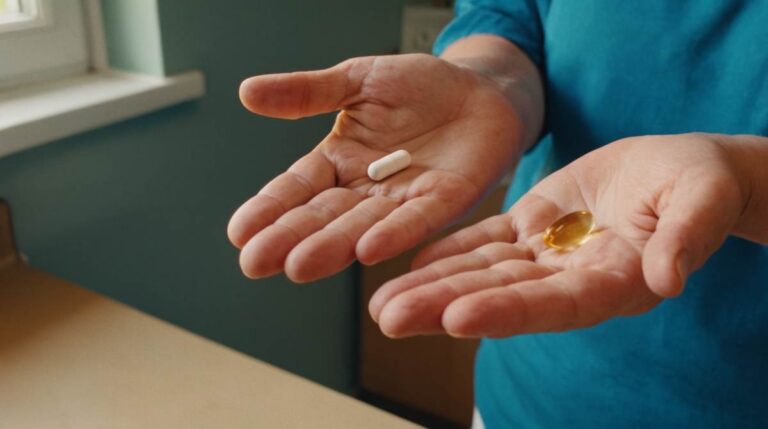
You were about to say it is just ginkgo, nothing like a real drug, when your eyes land on the bruise on your forearm. The bottle in your hand is the one you turned toward the light this morning, and the gray paragraph you finally read is still running through your head. So what does the record actually say, about the dose and about what happens when ginkgo meets your other medicine?
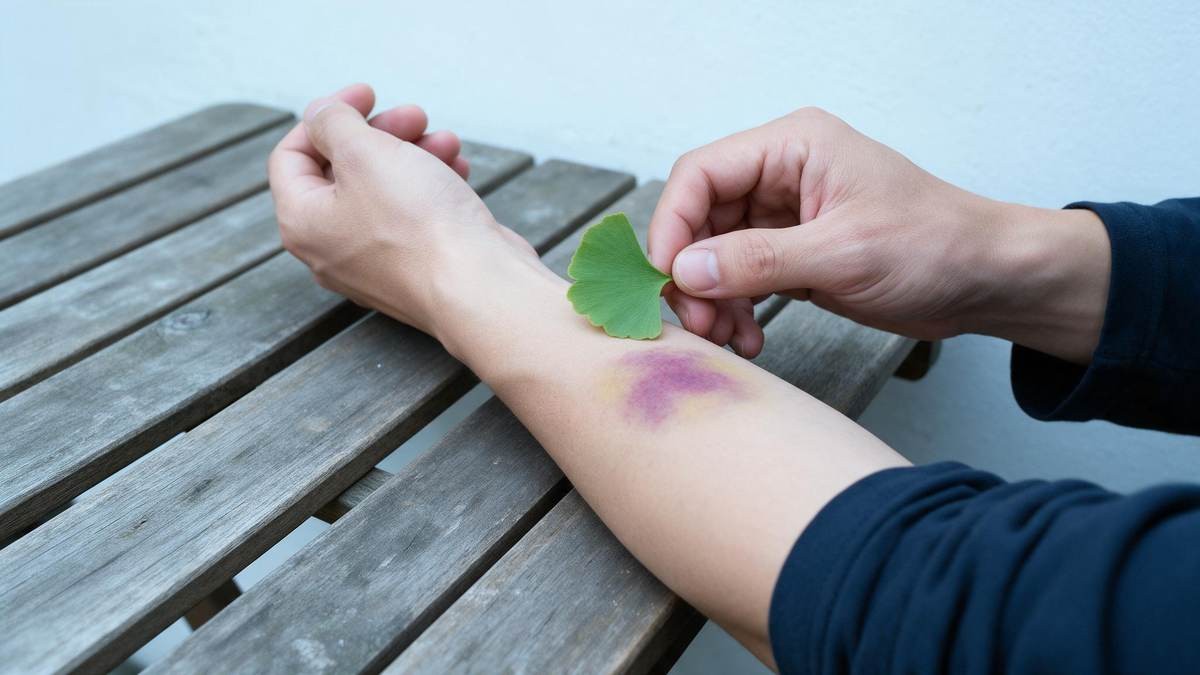 Why ginkgo makes bruises like thisWere you about to call it harmless?Watch the video for the rest of what sits in that gray paragraph on the label
You have been taking it for a few months, the tablet chalky and faintly bitter, the bottle kept next to the toothbrush because that is where you will remember to see it. Lately a bruise on your forearm takes longer to fade than it used to, and you find yourself trying to work out whether that started before the bottle or after it. The back of the label holds a small gray paragraph you have never read all the way through, and this morning you finally turn it toward the light. Ginkgo leaf extract is generally well tolerated for most adults when taken by mouth in moderate amounts, and the side effects reported most often are dizziness, gastrointestinal symptoms, and headache. It has been used safely in research studies lasting as long as six years. That sentence is the reassuring half. The other half sits in the same record: ginkgo may increase the risk of bleeding in people who take anticoagulant drugs such as warfarin, and it may interact with other drugs besides. Neither half tells you what to do about the bottle in your hand, so the rest of this page works through the interactions one at a time, the doses the trials actually used, and the people who are better off leaving ginkgo alone.
The bleeding question
Bleeding risk is the concern that follows ginkgo wherever it is discussed, and the wording in the federal summary is deliberately careful: ginkgo may increase the risk of bleeding in people who are taking anticoagulant drugs such as warfarin. The word doing the work is may. Nothing here says it happens to everyone, or that it happens at a particular amount, and nothing here lets you calculate your own odds. What the record supports is a conversation, before you start, with the person who prescribes your medicine.
It is rarely the side effect you feel. It tends to arrive as something someone else has to notice and manage.
The wider point is broader than one drug. Ginkgo may also interact with other drugs, and the standing advice is plain: if you take any type of medicine, talk with your health care provider before using ginkgo or other herbal products, because some herbs and medicines interact in harmful ways. Supplements sold for oral use are regulated differently from drugs. Unlike drugs, dietary supplements are not approved by the Food and Drug Administration before they are sold, and manufacturers and distributors are responsible for evaluating the safety and labeling of their own products. That gap is worth holding in mind when a bottle makes a claim that the research record does not.
You are in the pre-op holding area with the gown tied at the back when the nurse reads your list back and pauses at ginkgo. You were told to hold it before the procedure, and you have, but you cannot say for certain when the last tablet was, because the bottle went into the back of the cabinet instead of the trash. Nothing dramatic follows. What changes is the arithmetic: from then on you check every bottle against the next appointment, you write supplements down when you are asked what you take, and quietly the ginkgo stops being automatic. It becomes a decision you make before each blood draw, each dental visit, each plan for the weeks ahead.
What the trials actually used
A dose box only means something if you know where the numbers came from, so here is the shape of what the trials did and did not give people. The studied material: ginkgo leaf, usually as an extract, rather than the seed or the raw plant. The duration covered: research studies have used ginkgo leaf extract safely for as long as six years. The largest prevention trial: the Ginkgo Evaluation of Memory study, funded by the National Center for Complementary and Integrative Health and the National Institute on Aging, which assigned more than 3,000 people age 75 or older with normal cognitive function or mild cognitive impairment to a ginkgo supplement or a placebo for a median of 6 years. The result: no difference between the groups in the rates at which participants developed dementia of any type or Alzheimer’s disease.
Interaction list and what to do
| Medicine | What the record says | What to do |
|---|---|---|
| Anticoagulant drugs such as warfarin | May increase the risk of bleeding | Tell the prescriber before you start |
| Antiplatelet drugs | The same bleeding concern applies | The same conversation happens first |
| NSAIDs | Belongs to the same set of medicines | Bring them up in that conversation |
| Some antidepressants | Named among combinations that interact in harmful ways | Ask your prescriber first |
| Some seizure medicines | Named among combinations that interact in harmful ways | Ask first, do not assume compatibility |
The daily milligram range: the federal summary updated in February 2025 states no range for ginkgo leaf extract, so a milligram figure on a bottle is a manufacturer’s statement rather than a trial figure, and there is no settled amount for this page to hand you. Where benefit is even possible, the summary says a modest benefit for dementia symptoms may exist at relatively high doses, and the evidence is inconsistent.
What is settled is the negative side. Ginkgo has not been shown to be effective for any of the conditions for which it has been studied, and there is no conclusive evidence that it is helpful for any health condition. Three large studies in older adults did not find that supplementation reduced the risk of dementia. Work on cognitive performance in healthy people is mostly of low quality, and ginkgo has not been shown to be beneficial for preventing or slowing the progression of dementia.
Where the interactions sit
Read as a table, the interaction list is short and mostly repetitive, which is the point. Anticoagulant drugs such as warfarin: ginkgo may increase the risk of bleeding, so tell the prescriber before you start and do not change your own dose. Antiplatelet drugs: the same bleeding concern applies, and the same conversation happens first. NSAIDs: bring them up in that conversation too, since they belong to the same set of medicines people combine without thinking. Some antidepressants: named among the combinations that can interact in harmful ways, so ask your prescriber rather than assuming the two are compatible. Some seizure medicines: same instruction, ask first.
The what-to-do column is nearly identical in every row, and that is a useful finding rather than a lazy one. Talk with your health care provider before using ginkgo or other herbal products. Bring the actual bottle or write down what is on it, because the label name and the leaf name are not always the same word. If the answer is to continue, you have it in writing from someone who can see your full list; if the answer is to stop, you have not spent a month making the decision alone.
One category has its own instruction: a surgeon’s office will tell you to hold ginkgo before a procedure, and that instruction comes from the surgeon, not from the bottle. Follow it as given, and mention the supplement when you are asked what you take, since herbal products are routinely left off those lists by the people taking them.
The label conversation can wait until the weekend, and you can watch the full video after you have finished the rest of this page.
Why the seed is not the leaf
The distinction sounds pedantic until you read the safety note twice. Fresh ginkgo seeds are toxic when consumed orally, and serious side effects have also occurred in people who consumed roasted ginkgo seeds or the crude ginkgo plant.
Who is better off leaving ginkgo alone
- Anyone taking an anticoagulant drug such as warfarin
- Anyone taking an antiplatelet drug, an NSAID, some antidepressants, or some seizure medicines
- Anyone scheduled for a procedure, who holds it only when the surgeon says to
- Anyone pregnant, for whom it may be unsafe
- Anyone breastfeeding, where little is known about safety
- Anyone who takes any prescription medicine at all
That distinction does not transfer into a green light. The leaf extract is the form studied, and even for that form the record says only that it is likely to be safe for most adults in moderate amounts, with dizziness, gastrointestinal symptoms, and headache as the common complaints. Likely and moderate are doing a lot of work in that sentence, and neither is a dose you can measure.
The tree itself is a living fossil, the last remaining species of a primitive family of plants, with a long history in Chinese medicine for cough, diarrhea, and other conditions. History is not the same as evidence, and the current summary is blunt about the gap: ginkgo has not been shown to be effective for any of the conditions for which it has been studied.
Who should leave it alone
Anyone taking an anticoagulant drug such as warfarin: the bleeding risk is the reason to skip it or to have the conversation first. Anyone taking an antiplatelet drug, an NSAID, some antidepressants, or some seizure medicines: the same rule, because the interaction list is not long but it is not optional either. Anyone scheduled for a procedure: hold it only when your surgeon says to hold it, and say so when asked. Anyone pregnant: it may be unsafe, and it might cause early labor or extra bleeding near the time of delivery. Anyone breastfeeding: little is known about whether it is safe, which is a reason for caution rather than confidence. Anyone who takes any prescription medicine at all: talk with your health care provider first. Anyone with raw seeds in the kitchen: fresh seeds are toxic, and roasted seeds and the crude plant have caused serious side effects.
The check that catches most people is the last one on a pharmacy questionnaire rather than the first: what supplements are you taking. Answer it. Herbal products are regulated in a variety of ways depending on what is in them and how they are used, and the rules for making and distributing dietary supplements are less strict than those for drugs, so nothing on the label has been reviewed by a public body before it reached you.
Underneath the restart is a larger question this page deliberately leaves open: what is a person actually reaching for when they go back to a bottle the trials did not reward, and does knowing that change what they should do with it? We have no view to offer here. The question stays where it is.
Blood pressure, sex, and older age
On blood pressure, the record points the opposite way from the marketing: research suggests that ginkgo is not helpful for treating high blood pressure. The summary does not report blood pressure change as a side effect of the leaf extract either, and good evidence on that specific question is thin, so a number you see quoted elsewhere is not one this page can stand behind. If you are tracking your readings at home, the readings and your prescriber are the better source than a supplement label.
What the trials actually did
- Research studies have used ginkgo leaf extract safely for as long as six years
- The largest prevention trial assigned more than 3,000 people age 75 or older
- Participants took a ginkgo supplement or a placebo for a median of 6 years
- No difference in dementia rates between the two groups
- The federal summary updated in February 2025 states no milligram range
On sexual side effects, the federal summary describes nothing, and other effects named are dizziness, gastrointestinal symptoms, and headache. An absence in a summary is not a finding, and it is not reassurance either. Good evidence on that question is thin, and anyone noticing a change while taking ginkgo should raise it with their health care provider rather than waiting for it to resolve.
Older readers sit closest to both halves of the ledger. The largest prevention trial enrolled people age 75 or older and ran for a median of 6 years with no difference in dementia rates against placebo, and the extract has been used safely in research for as long as six years. Against that sits a real interaction list, dizziness as a common complaint, and no demonstrated benefit for any health condition. For many older readers that trade does not convince, which is exactly why we keep coming back to it rather than treating ginkgo as an ordinary default.
Once you have set the interaction list against your own medicine cabinet, the remaining case for keeping ginkgo is worth hearing in full, and it is here: watch the full video.
Everything on Supplements & food →
▶ Watch the memory video