The reply was already forming when the table laughed, and you realized you had caught the rhythm of the joke, not the words. You nod anyway, and it passes for agreement. You have been doing this at the phone call, at the book club, at the dinner for a while now, and you have gotten good at covering it. What you have not settled is why this habit lands on a list of risks you can still change, and what a hearing test would actually tell you.
You are at a table with four other people. Someone across from you says something and half the table laughs. You caught the shape of it, the rhythm, the way her shoulders moved, but not the words. You smile and hope that is the right response. Later you realize you have been doing this for a while, filling in gaps with a nod, a small laugh, a guess. The noise of the room has become a wall. That is the moment when hearing stops being background and becomes a thing you manage. And it is the moment when a different question often surfaces, because hearing loss appears on the short list of health conditions that researchers link to a higher risk of Alzheimer’s disease and other dementias. The National Institute on Aging lists hearing loss among the medical conditions associated with a higher risk. It also lists it among the factors that can be addressed, alongside high blood pressure, physical inactivity, social isolation, and others. The practical step is straightforward: get your hearing checked. A hearing test is not a diagnosis of anything. It is a measurement, and it gives you a baseline. But the reason hearing keeps coming up in these conversations is not as simple as a single cause. The NIA is clear that researchers cannot yet say for certain whether treating a condition like hearing loss reduces the risk of dementia. What they can say is that the association is consistent, and that addressing it is part of taking care of your overall health.
What the list actually says
The NIA’s list of health and lifestyle factors that may contribute to Alzheimer’s risk includes hearing loss, depression, mild cognitive impairment, and concussion or other traumatic brain injury. A separate list of lifestyle factors to address includes unmanaged chronic health issues such as high blood pressure or hearing loss, physical inactivity, unhealthy diet, alcohol misuse, smoking, not getting enough sleep, social isolation, and lack of mental stimulation. These are population-level observations, not personal predictions. The presence of hearing loss on both lists is why it gets so much attention: it is common, it is measurable, and it can be treated.
What a hearing test tells you
| Question in your head | Where the test stands |
|---|---|
| Sounds at different frequencies | Yes, that is what it measures |
| Memory, thinking, reasoning | No, it does not measure those |
| A baseline you can compare later | Yes, it gives you that |
| A diagnosis of anything | No, it is not that |
What it costs when hearing loss keeps going unaddressed is not just missed words. It is the book club you stop attending because you cannot follow the discussion. It is the phone call you let go to voicemail because the phone is the hardest place to hear. It is the dinner where you nod along and hope. Over time, you start avoiding the situations where hearing is hard, and that avoidance is itself on the list. Social isolation is one of the factors associated with higher risk. The thing you do to protect yourself from embarrassment may add another risk factor. That is the cost: a smaller circle, a quieter life, and one more item on the list.
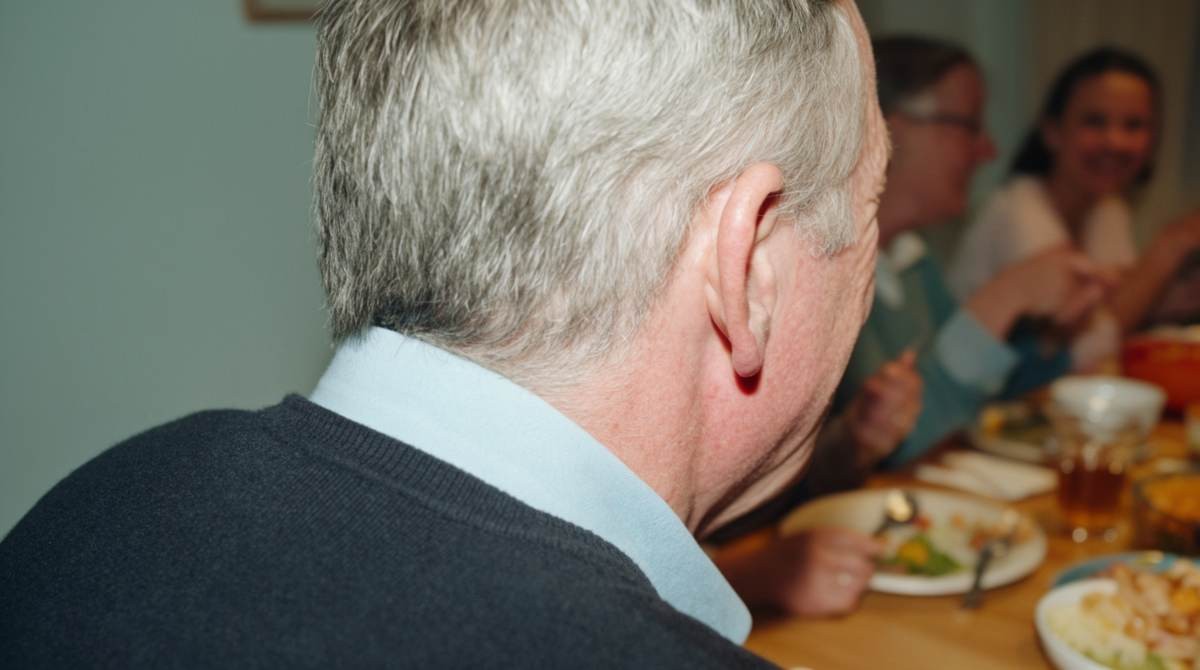 Straining to catch this dinner talk?What is the quiet costing youWatch the video and see how a simple hearing check fits into the conversation
Why a hearing test is not a dementia test
A hearing test measures how well you detect sounds at different frequencies. It does not measure memory, thinking, or reasoning. If you have trouble hearing, that is a hearing problem, and it may have several causes, from wax to noise exposure to age-related changes. The test itself is simple and non-invasive. What it gives you is information. If your hearing is reduced, you can decide what to do next, whether that is a hearing aid, a different seating arrangement at meetings, or simply telling people you need them to face you when they speak. None of that is a treatment for dementia. It is a treatment for hearing loss, which is worth doing on its own.
If you want to keep going, watch the full video with us.
The two leading explanations, and why neither is settled
One explanation is that when hearing declines, the brain has to work harder to decode sound, leaving fewer resources for other tasks like memory and attention. Another is that hearing loss often leads to social withdrawal, and social isolation is itself on the list of factors associated with higher risk. Both explanations are plausible. Neither has been proven to cause dementia. The NIA notes that research may in time clarify whether reducing risk factors for these conditions also reduces the risk for Alzheimer’s. For now, the honest position is that the association is real, the mechanism is not pinned down, and the advice to address hearing loss stands on its own merits.
The question trials have not answered
The evidence on hearing aids and dementia risk is thin. The NIA says researchers cannot yet say for certain whether making positive changes in these areas can prevent dementia. That is not the same as saying it does nothing. It means the question is still open. A hearing aid is not a dementia prevention strategy. It is a hearing strategy. If it helps you follow conversations, that is a real benefit. If it also turns out to have an effect on risk, that would be a bonus, but the evidence is not there yet.
Noticing before you act
- If the phone is the hardest place to hear, notice it
- If restaurants are where you struggle, notice it
- If the car is where words drop away, notice it
- If you notice a sudden change in hearing, contact your doctor
- If you are not ready for a test, tell people you are having trouble
The larger question is why hearing loss appears on these lists at all. Is it a cause of cognitive decline, a consequence of the same underlying process, or a marker of something else entirely? Does treating it change the trajectory, or does it simply make the years more comfortable? The page does not settle that. The research is not there yet. We keep coming back to this because the question is important and the answer is still open. What we do know is that hearing is one lever on everyday memory, and there are others.
What to do with this if you are the one asking people to repeat themselves
Get your hearing checked. That is the step box. The NIA lists hearing loss as a condition to manage. Your doctor can do a basic screening or refer you to an audiologist. If you are not ready for that, start by noticing when you struggle: in restaurants, in the car, on the phone. Tell the people you talk to most that you are having trouble. Ask them to face you, to speak a little slower, to rephrase rather than just repeat louder. Those adjustments cost nothing and they preserve the conversation. If you notice a sudden change in your hearing, contact your doctor.
Myths about the link
- Myth: treating hearing loss prevents dementia. Fact: researchers cannot yet say for certain.
- Myth: a hearing aid is dementia prevention. Fact: it is a hearing strategy.
- Myth: the lists predict your own risk. Fact: they are population-level observations, not personal predictions.
- Myth: the mechanism is settled. Fact: the association is real, the mechanism is not pinned down.
If this has you thinking about what else you can do, watch the full video. It is a good place to start.
Everything on Memory loss & dementia →
▶ Watch the memory video