Your coffee has gone warm on the counter and you are on the third pass over the same paragraph. The room is quiet enough to hear the clock. You get up because sitting has stopped helping, walk the hall twice, do a few squats beside the linen closet, and sit back down. The paragraph is where you left it, no easier the fourth time than the first. A seven-minute bout of movement gives attention a small lift that fades within the session, and helps with some memory tasks while it lasts. It does not increase brain power. Good human trials on that specific window are scarce, and published guidance gives no dose. A useful study would fix the length and intensity of the bout, test the same people on the same attention and memory tasks immediately before and after, retest them at a fixed later point, and say plainly whether anything was still there the next day.
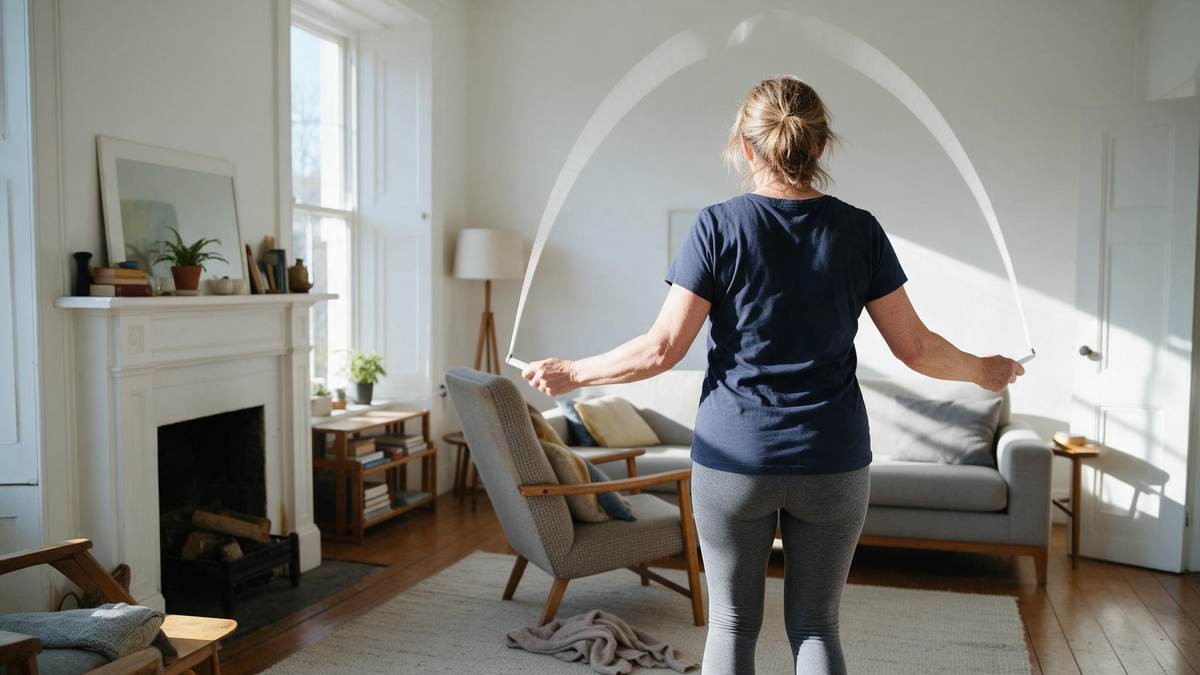 Jumping rope in her living room?Sharper at eleven, then whatWatch the video to see where that lift goes once the session ends
What a useful study would have to measure
The claim in front of us is specific enough to test: a short burst, a short window, a measurable change. Someone has to fix the bout first, its length and how hard it is, and say so in the paper. Then the same people do the same attention task before and after, and the same memory task, and the results are reported as the size of the change rather than as a story about sharper thinking. A control condition matters too, because part of any lift comes from getting out of the chair, from the light, from being watched while you try.
Without those pieces, all you have is a morning that felt better. That is worth having. It is not a measurement, and it does not tell you what to do on the next morning, or whether the third day would feel the same.
What exists is thinner than the claim. Published reviews of short bouts point at the same shape: attention and memory tasks measured in the period right after movement, a small improvement, then a fade over a short window, well before the next day. Nothing in that pattern stores itself. The National Institute on Aging places cognitive health alongside physical health, sleep, sensory conditions and medicines, and treats staying sharp as several moving parts rather than one session.
On Thursday you do the routine before you open the document, the opening minutes go well, and then the same wall arrives. You begin timing your sessions against the lift instead of against the material. The reading that used to take one sitting gets split into two, then three. You stop asking why the paragraph is hard and start asking what you did wrong that morning. The walk to the hall becomes the thing you protect, and the work it was meant to serve becomes the thing you move around.
The lift leaves before the session does
The mistake is arithmetic. You feel sharper at eleven, still feel it at noon, and decide the burst added something that is now yours to keep. What was added is a state, not a structure: a little more arousal, a lifted mood, a task briefly made easier. States end. The next time you sit down you are working with whatever sleep, stress and attention you brought to the desk, plus nothing.
What the lift is, and is not
- Feels sharper at eleven, then still at noon: that is a state, not a structure
- Published reviews show a small lift, then a fade well before the next day
- Federal guidance sets a weekly total, not one session with a job to do
- Part of the lift comes from getting out of the chair, the light, being watched
- Nothing in that pattern stores itself overnight
The wider evidence is slower. Federal guidance for adults sets a weekly total for physical activity, not one session with a job to do, and it offers walking as a good start. Research has connected being active with strength, balance, mood and energy, and with markers of brain health including how quickly brain tissue uses glucose. Researchers describe that picture as encouraging and unfinished. The loop is what separates a quick lift from recall you can rely on: what happens across weeks, alongside sleep, blood pressure, hearing, vision and the medicines you take.
We keep the longer version open beside the timer and watch the full video whenever a short burst gets credited with more than it does.
What does the routine actually ask of you?
There is no published dose for this, so what follows is a shape rather than a prescription. It runs in the window you searched for, needs no equipment, and asks nothing of your knees that a chair cannot give you. Keep the pace conversational, keep a counter or a hallway wall within reach, and let the last minute bring you back down to normal breathing.
Walk the length of the hall and back until your breathing lifts. March in place, arms loose, shoulders down. Squat to a chair and stand, weight in your heels. Calf raises at the counter, hand resting, not gripping. Side steps along the hallway, chest tall. Easy overhead reaches, no strain through the neck. A slow walk back to the desk, breathing settled, then sit down.
Treat it as a warm-up for the hour ahead, not as the work. Its job is to change how the next stretch of sitting feels. The reading still has to be done, and it will still be hard on the days when sleep was short or the stress never let go.
Why the same routine feels different on Thursday
The same seven minutes are not the same seven minutes twice. Sleep is the largest lever: guidance for adults is a full night rather than a trimmed one, and interrupted sleep impairs clear thinking, quick reactions and the forming of memories. Long-term stress works alongside it, keeping alertness hormones up for weeks, until you stop noticing the headache and the short fuse and mistake a busy mind for a sharp one. Someone who slept badly and moved anyway will still have slept badly, and the paragraph will still take the fourth pass.
Medicines belong in the same picture. Some carry confusion, memory loss, hallucinations or delirium as effects in older adults, and some interact with alcohol or with each other. The desk’s note on this is simple: raise it with your doctor, and never stop a prescribed medicine on your own to test a theory about your memory. Blood pressure, depression, and hearing or vision loss sit in the same category, each worth a visit for its own sake.
The question underneath the slip is not why you lost the name this time. It is what holds a memory in place from one week to the next, when attention can be lifted for a stretch and then settle back to where it started. Two afternoons, the same person, the same material, different recall. We are leaving that open here.
Where the routine stops
Stop the routine and get help immediately if something acute arrives: chest pain, sudden weakness, trouble speaking, confusion that comes on quickly, or a fall you cannot get up from. That is 911 or the emergency room, not a change to tomorrow’s schedule. If the room tilts, if your breath will not settle, sit down where you are. For heart conditions, balance problems, recent surgery or a history of falls, ask your doctor before a vigorous session, and let a chair or counter stay under your hand the whole way through.
The routine, from hall to desk
- Walk the length of the hall and back until your breathing lifts
- March in place, arms loose, shoulders down
- Squat to a chair and stand, weight in your heels
- Calf raises at the counter, hand resting, not gripping
- Side steps along the hallway, chest tall
- Easy overhead reaches, then a slow walk back to the desk
A change in memory that persists or gets worse deserves an appointment on its own account. The causes of memory trouble are several and they do not volunteer: blood pressure, depression, stroke, delirium after a hospital stay, sleep, hearing or vision loss, and medicines that affect how the brain works. Bring the list of what you take and the days the slips happen.
What we would want measured is the part everyone skips: the same person, the same tasks, a fixed point days later, and a condition that accounts for the walk to the hall. Until that exists, the claim should be carried at the size it has been tested at, and no larger.
When the summary stops being enough, sit down with the whole thing and watch the full video before you decide anything.
▶ Watch the memory video