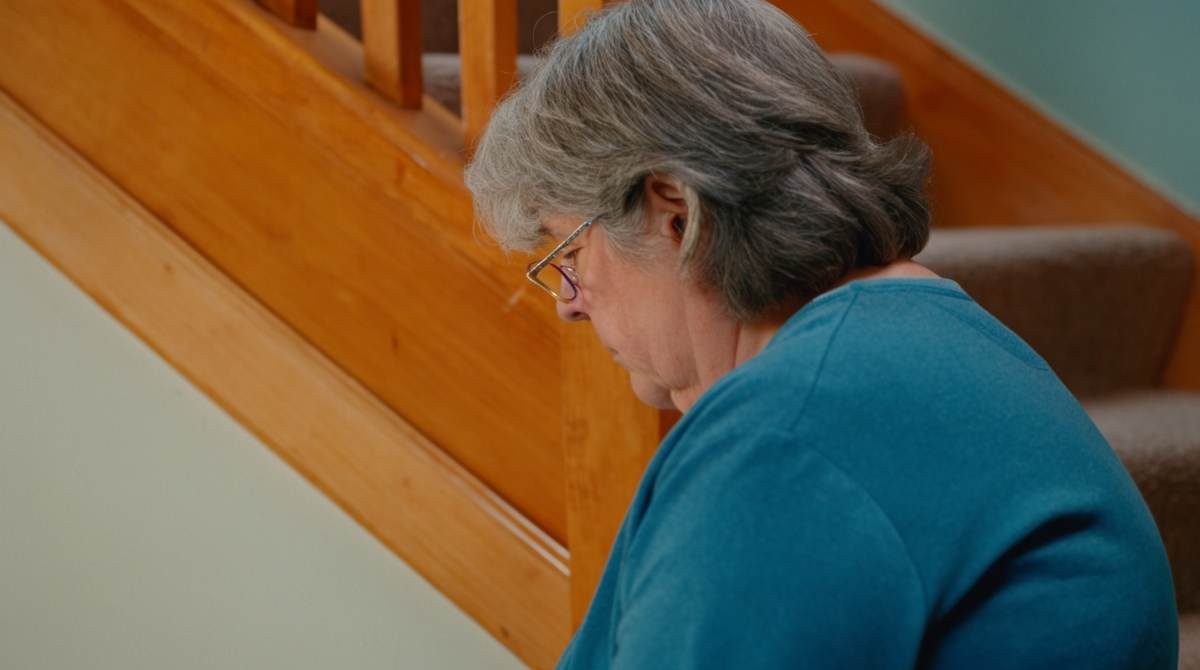
You are holding the printed visit summary in both hands at the bottom of the stairs, the dryer still buzzing down the hall. You have read the diagnosis line four times and each reading sounds like a different sentence. Nobody in the room said those characters out loud. What is that single row of letters and periods actually saying about your days?
 Worried what your visit code implies?What your diagnosis line leaves outWatch the video on how one line in your summary gets chosen and what sits behind it
The visit summary is open on your phone at the kitchen counter, the screen bright against the tile, and you have read the same line under diagnoses four times. Each reading seems to say something slightly different. The coffee beside the phone has gone cold. You are not looking for a verdict, you are looking for a string of characters you can look up, and it sits in a row of letters and periods that nobody said out loud in the room. Mild cognitive impairment has its own entry, carried under the official title mild cognitive impairment so stated, and it is used when the clinician wrote that wording into the record. The characters beside the title are how the office finds the entry again later. Check them against the current CMS ICD-10-CM release before you rely on them, because this part of the codebook has been revised. Everything else you can see on that page is a translation problem: a short, fixed label standing in for a conversation that had nuance in it, room in it, and a person in it.
What the line under diagnoses is actually doing
A visit summary is the readable face of a coded record. The clinician writes what you described and what they observed, and an entry is chosen from a fixed list to match that wording. The list exists so records can be counted, compared, and passed between offices, and it leaves almost no room for nuance. That is why the same experience can appear as a symptom on one visit and as a named condition on the next. Partly this is coder intent: two careful readers of the same note can settle on different entries, one describing what was felt, one describing what was concluded.
Read the official title first and the characters second. The title is what a person wrote down. The characters are how the record finds that entry again months later when the visit is filed, counted, and pulled up beside the last one.
In the car outside the clinic, before you have turned the key, you open the summary and the diagnosis line reads what it read at the last follow-up, character for character. You scroll to the top anyway and read the visit note in order this time, then the medications, then the plan. On the drive home you do not ask the question you had rehearsed in the waiting room. At the next appointment you stop asking it out loud. You still open the portal, but only for this one line, and only after everyone else has gone to bed.
Four entries, four different sentences
Four lines account for most of what a patient sees in this part of the page. They are not four versions of one finding, and they do not carry the same weight. Below is each one in the words it actually uses, what it means in plain English, and what usually follows it at the office.
Mild cognitive impairment so stated: the record names mild cognitive impairment as the reason for the visit. In plain words, the clinician documented more memory or thinking trouble than others of your age while you still handle your own day-to-day tasks. What usually happens next: tests and assessments to find the source, a possible referral to a neurologist, and a follow-up every six to 12 months.
Age-related cognitive decline: the wording ties the change to getting older without naming a disease. In plain words, forgetfulness was recorded as part of aging rather than as a separate condition. What usually happens next: a doctor looks for other reasons, because memory problems can come from depression, sleep, medicines, thyroid, kidney or liver trouble, head injury, blood clots, or low vitamin B12, and the cause decides the plan.
Other cognitive symptoms: a symptom-level entry, used before a cause has been settled. In plain words, the record states that memory, attention, or thinking was off, and stops there. What usually happens next: further assessment, sometimes a specialist, sometimes scans, with the wording updated once more is known.
Dementia: an entry for loss of thinking and behavioral abilities serious enough to interfere with daily life and quality of life. In plain words, the record has moved past a symptom to a named syndrome, which may be Alzheimer’s disease, vascular, Lewy body, or frontotemporal. What usually happens next: a diagnosis-specific plan, further testing, and follow-up on how everyday tasks are going.
If your entry reads age-related and you would rather begin with ordinary days than with a code, we would put. watch the full video on for a quiet hour after dinner.
What age-related leaves out
Age-related describes when, not why. The National Institute on Aging puts it plainly: changes in memory and thinking are usually mild forgetfulness and a normal part of aging, while more serious problems may be due to mild cognitive impairment, dementia, or other factors beyond normal aging. The entry cannot tell you which of those a note contained, because it records the wording rather than the reasoning behind it.
Four entries you may see on the summary
| Entry wording | Plain English | What usually happens next |
|---|---|---|
| Mild cognitive impairment so stated | Memory or thinking trouble while daily tasks are still handled | Tests and assessments, possible neurologist referral, follow-up every six to 12 months |
| Age-related cognitive decline | Forgetfulness recorded as part of aging, not a named disease | A doctor looks for other reasons, since many causes fit the same symptom |
| Other cognitive symptoms | Memory, attention, or thinking was off, and the wording stops there | Further assessment, sometimes a specialist, sometimes scans, wording updated later |
| Dementia | Loss of thinking and behavioral abilities affecting daily life and quality of life | A diagnosis-specific plan, further testing, follow-up on everyday tasks |
This is where the label costs people something. A line about age-related decline can sit on the summary through several visits while a treatable reason, if one is there, waits to be named. Finding the cause is what determines the course of action, and more than one cause fits the same symptom. If your entry reads age-related and you would rather begin with ordinary days than with a code, we would put watch the full video on for a quiet hour after dinner.
Why the entry is not a forecast
The entry that names mild cognitive impairment is read as a prediction by nearly everyone who sees it, and the source material does not support that reading. The NIA notes that MCI may be an early sign of Alzheimer’s disease, and equally that not everyone with MCI will develop it. An estimated 10 to 20% of people age 65 or older with MCI develop dementia over a one-year period. In many cases symptoms stay the same or even improve.
There is also no proven drug treatment for MCI at this time, which is why the plan on the page is a schedule rather than a prescription: memory and thinking checked every six to 12 months, a record of changes kept between visits, and steady attention to the factors a person can manage, such as blood pressure, sleep, and mood. The code tells the office what to book. It does not tell you which way anything is heading.
Which of the several causes behind a slip that keeps returning was this visit actually about, and what would it take to read that off the wording alone? Two people can choose different entries from the same note, so the label tells you what got written down, not what got considered. We are leaving that open here, because the codebook is the wrong place to settle it.
The question worth asking at the next visit
Bring the printout, not just the worry. Three questions settle most of the confusion: what exact wording went into the note, what else was considered and set aside, and when the next check is scheduled. Ask who to contact between visits if something changes. If you can, bring someone who hears you day to day, since a second account of the same weeks tends to be more specific than either of you remembers alone.
Three questions that settle most of the confusion
- What exact wording went into the note?
- What else was considered and set aside?
- When is the next check scheduled?
- Who should I contact between visits if something changes?
- Can someone who hears me day to day come along?
And know when contact should escalate. Memory problems that persist after a few weeks deserve a doctor’s appointment, as do repeated questions, getting lost in familiar places, trouble following recipes or directions, and difficulty with tasks you handle every day. Sudden confusion, or a change in thinking that arrives quickly, warrants a call to 911. A code on a summary opens that conversation. It does not close it.
The entry itself is settled on the page; the conversation it belongs to is not, and that is the part we would hand over now: watch the full video.
Everything on Memory loss & dementia →
▶ Watch the memory video