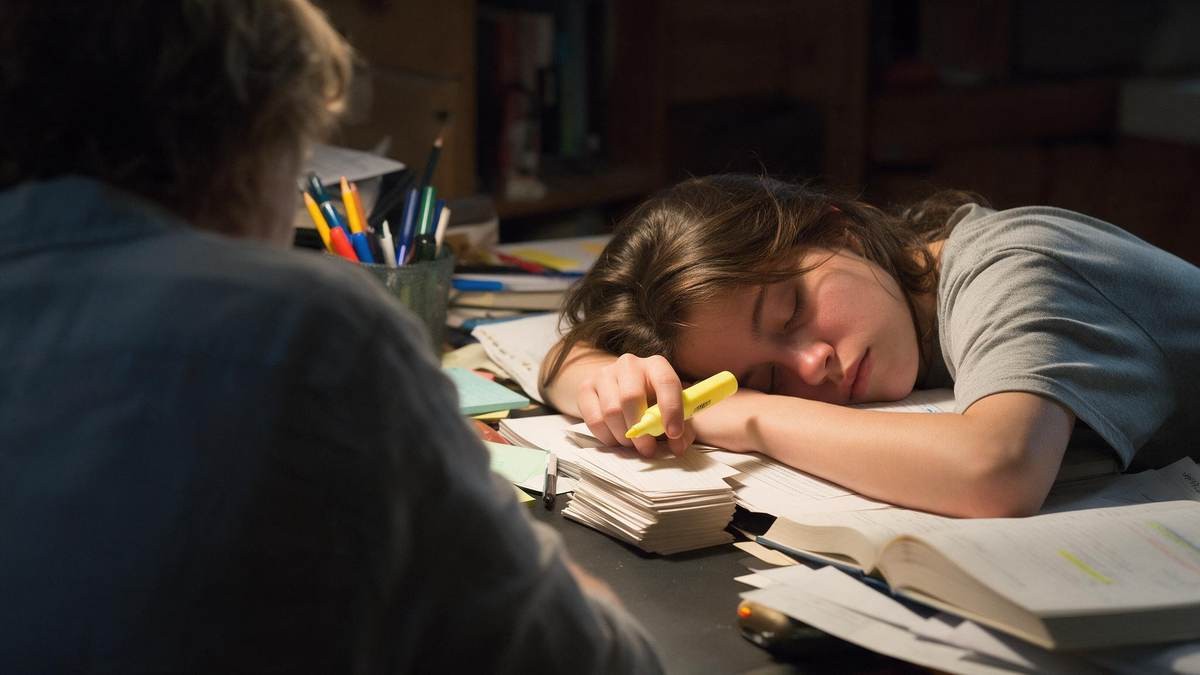
You glance at the highlighted page in front of you and realize the words look familiar but the meaning has already gone quiet. The lamp is on, the phone is face down, and still the paragraph will not hold. Maybe the problem is not your memory but the order in which you study. What if the weakest step is the one that feels most like work?
 Your notes never stick? The real reasonThe study habit that feels productive butWatch the video to see the simple switch that makes the same hour of study actually stick.
You sit down with a textbook or a course module, read the same paragraph twice, and still feel the words slide away the moment you look up. The tension is familiar: the effort feels like studying, but the memory does not stick. The useful answer is that rereading is one of the weakest ways to study, and the methods that beat it are simple enough to use in ten minutes. Retrieval practice, spacing, interleaving, and explaining the material to yourself all build a stronger trace than another pass of the highlighter. You do not need a special brain or a long block of time. You need a different order of operations: close the book, test yourself, wait, mix the topics, and say it in your own words.
Why rereading feels productive but fails
Rereading creates fluency. The text becomes familiar, and familiarity feels like learning. But recognizing a page is not the same as being able to produce the answer from memory. The distinction matters because most exams, conversations, and real-world decisions ask you to recall, not to recognize.
Ten-minute retrieval session
- Read the section once.
- Close the book or notes.
- Write down everything you can remember.
- Check what you missed.
- Repeat after a day, then after a week.
A large review of study techniques found that rereading and highlighting were among the least effective methods for durable learning. The researchers rated techniques on their utility for improving long-term retention and comprehension. Rereading showed low utility, especially when compared with methods that force the learner to generate an answer before seeing it again.
The mistake people make is to keep rereading until the material feels smooth. That smoothness is a trap. It tells you the information is in your working memory right now, not that you will be able to find it next week. The fix is to interrupt the rereading with a blank page and a question.
Retrieval practice: close the book and answer
Retrieval practice means pulling information out of your memory rather than putting it back in. You read a section once, close the book, and write down everything you can remember. Then you check what you missed. The checking is where the learning happens.
The same review of study techniques rated practice testing as having high utility. It worked across ages, subjects, and delay intervals. The benefit appeared even when the testing was brief and informal. A ten-minute self-quiz after reading beats another ten minutes of rereading.
You can do this with flashcards, with a blank sheet of paper, or with questions you write yourself. The key is that the answer must come from memory first. If you flip the card too early, you have turned retrieval into recognition, and you lose most of the benefit.
Spacing: let the memory cool before you reheat it
Spacing means leaving time between study sessions on the same material. Instead of studying a topic for three hours on one evening, you study it for one hour, then again a day later, then again a few days after that. The gaps feel inefficient, but they are doing the work.
The review of study techniques rated distributed practice as having high utility. Learners who spaced their sessions remembered more than learners who crammed the same total time into one sitting. The effect held across many kinds of material and many kinds of learners.
A practical version is to study something today, test yourself tomorrow, and test yourself again in a week. Each time you retrieve the memory after a gap, you make it easier to find the next time. The forgetting between sessions is not a failure. It is the signal that tells your brain the memory is worth keeping.
Interleaving: mix the topics instead of blocking them
Interleaving means studying related topics in a mixed order rather than finishing one topic completely before starting the next. If you are learning three formulas, you practize them in rotation: formula A, formula B, formula C, then A again. The switching feels harder, and that difficulty is the point.
The review of study techniques rated interleaved practice as having moderate utility, with the strongest evidence in mathematics and motor learning. The benefit comes from learning to choose the right method for the problem, not just from repeating the method. Blocked practice lets you coast on the same operation. Interleaving forces you to discriminate.
The trade-off is that interleaving feels worse in the moment. You make more errors, and the session feels less tidy. But the errors are part of the learning. If you always know which technique to use because you just used it, you have not practized the choice that the exam will actually require.
Explaining it to yourself: the Feynman technique without the name
Explaining the material in your own words, as if to someone who has never heard of it, exposes the gaps that rereading hides. You take a concept, say it out loud or write it down in plain language, and notice where you stall. The stall is the gap. Go back and fill it, then explain again.
This method works because it combines retrieval with organization. You are not just recalling facts. You are building the links between them. When you can explain a concept without jargon, you have understood it well enough to use it. When you cannot, you have found the exact spot that needs more work.
The mistake people make is to explain only to themselves, in their head, and to accept a vague sense of understanding. Put the explanation on paper or say it aloud. The extra step of producing language makes the gaps visible. A fuzzy mental nod is not an explanation.
Studying at home: one place, one phone rule, one quiet window
Studying at home adds a layer of friction that a library or classroom removes. The fix is to reduce the number of decisions you make before you start. Choose one set place for studying, and use it only for that. The place becomes a cue, and the cue makes starting easier.
When studying feels too smooth
- If the page feels familiar, then close it and test yourself.
- If you want to flip the card early, then write the answer first.
- If the session feels harder, then you are more likely building recall.
- If you stall while explaining, then you have found the gap to fill.
Put your phone in another room, not just face down on the desk. The presence of a phone, even silent, draws attention away from the material. The cost is not only the minutes you spend looking at it. The cost is the time it takes your attention to return fully to the page after each glance.
A quiet window helps because it gives you a defined block of time. Tell the people you live with that you are studying for the next hour, close the door if you can, and set a timer. The timer does two things: it makes the session feel finite, and it gives you permission to stop when it rings. You do not need a perfect home office. You need a repeatable routine.
The single slip is the small version of it, so watch the full video about the one that keeps returning.
If the same blank keeps arriving in different rooms, watch the full video and sit with what it suggests about the pattern.
Everything on Memory training →
▶ Watch the memory video