Your neighbor asks, “Wednesday cards — are you coming this week?” and a ready-made excuse about a headache forms before you finish hearing it. The half-finished crossword waits beside you on the table. Here is the part this page has not settled: whether a week of puzzles reaches memory at all, or only the standing hour with other people does.
Your neighbor asks, “Where were you on Wednesday?” and the excuse — a headache, an errand — is already shaped before you answer. You rate your own memory highly, and the harder question sits underneath: does a week of puzzles at the dining table actually reach memory, or is it only the hour with other people that carries anything?
You are halfway through a crossword you have done a hundred times, one thumb holding the newsprint flat against the table, pen hovering over a four-letter word for a bird. It will not come. You know you know it. You set the pen down, pick it up, read the crossing answers again, and the word stays just past reach. It arrives twenty minutes later while you are rinsing a cup, which is somehow worse. If you searched for free brain games for seniors, the list is short and costs nothing beyond paper and company: large-print word searches and crosswords, sudoku and other number puzzles printed at whatever size you need, a deck of cards for solitaire or rummy, dominoes, checkers, chess, a jigsaw left on a side table, trivia called out loud, bingo across a room, and any guessing game that gets people talking. Every one of them can be enlarged, slowed down, spoken instead of read, or played with one hand. Be equally straight about what they are worth, because good human trials of free brain games are scarce and published guidance gives no dose. Nobody can tell you how many puzzles a week leads to a measurable change. A useful study would have to show that any gain leaves the puzzle page and shows up in ordinary tasks such as keeping track of appointments, paying bills and cooking, and that it holds after the playing stops. That work has barely begun for games you can print at home.
Why the evidence for free games is thin
The clearest work in this area has been done on structured cognitive training, where memory, reasoning and processing speed were taught deliberately rather than picked up at a card table, and even there the pattern was uneven. Some trained abilities held their ground longer than others. Practicing one skill is not the same as improving memory in general, and a gain on one task does not automatically travel to the next one.
Alone at the table or with company
| Trade-off | Playing alone | Playing with others |
|---|---|---|
| Attention | Can be abandoned mid-sentence | A partner keeps the session going |
| Recall | Rewards quiet and stamina | Rewards recall out loud |
| Pace | Nobody watching the pause | A slow answer is forgiven |
| Difficulty | Set by yourself | Halved or slowed by agreement |
The market runs ahead of the research. Federal health guidance warns plainly that there is not enough evidence to say commercially available brain-training programs have the same impact on cognitive abilities as structured training does. An app reporting a rising score is reporting performance on that app. It is not a memory test, and it does not tell you whether you handled the recipe, the bus route or the bill folder better this month.
So treat free games as an activity with a plausible upside and an unproven one. Play them because they are enjoyable, social and cost nothing, and let the claims stay modest. We keep coming back to this: the honest version serves a reader better than the promised one.
When it keeps happening, the cost lands in the invitation. The neighbor asks about Wednesday cards and a ready excuse appears: a headache, an errand, a preference for television. The crossword gets handed over mid-week. The trivia night at the library stops being mentioned at all. Eventually the free game costs the reader the thing that made it worth playing, which was a standing hour with people who did not notice the pause. What gets avoided next is not the puzzle. It is being seen pausing.
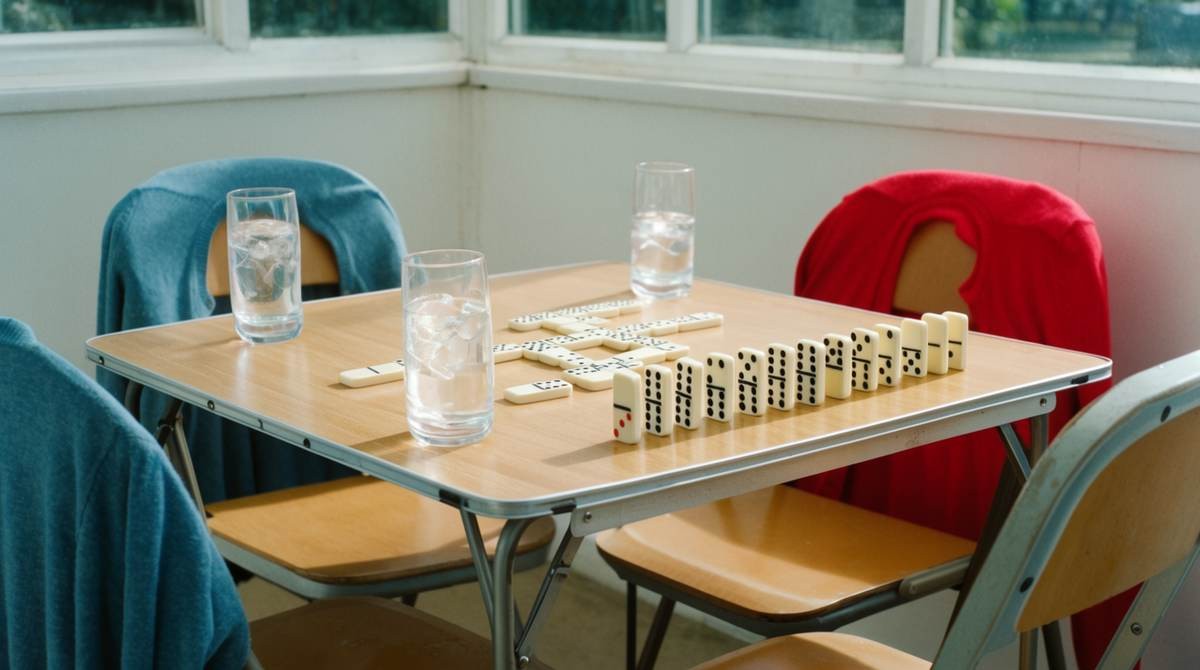 Playing alone falls flat? Here is whyDoes the puzzle or the room matter moreWatch the video to see how a table, a lamp and some company fit together
Does the game fit the hands and eyes that have to play it
Most games fail a person before they fail anyone’s memory. The print is too small, the cards slide off a polished table, the rules are read aloud quickly, nobody announces whose turn it is, and the lamp sits behind the reader’s head. Fix the format first, and the same game usually becomes playable.
For playing alone: a printed puzzle at the largest size the paper allows, a jigsaw worked standing at a counter, or solitaire where cards can be laid down and left in place between hands.
For playing with a partner: a two-hand card game, draughts, or a crossword read aloud so one person can offer a hint without taking the pen.
For a group: trivia, bingo, dominoes, or a story-building game where nobody has to write, hold, or lean in to see the table.
For low vision: genuinely large print, high-contrast ink, a felt-tip instead of a fine ballpoint, and a lamp on the table rather than overhead glare that washes the page out.
For hearing loss: games where the turn is signaled by a visible gesture as well as a voice, a quiet room before a noisy one, and play done face to face rather than across a hall.
For arthritis or playing one-handed: cards fanned and rested on the table instead of gripped, chunky tiles, a board that does not slide, rules that accept pointing as a move, and no penalty for asking a question twice.
None of these adjustments is a concession to age. They change who can join the table, which matters more than whether the puzzle is hard.
If you want to see how other people arrange this, watch the full video while the kettle boils.
A sample week you can copy
Published guidance gives no dose, so treat this as a shape rather than a prescription. It assumes a printer, a deck of cards, a lamp and at least one other person, and any line can be swapped for something you already like.
Monday: a word search or sudoku at the kitchen table, alone, stopped the moment it stops being fun.
Wednesday: cards with a neighbor at the same hour each week, lamp on, table cleared so nothing slides.
Friday: trivia or bingo in a community room, called out loud, with large-print sheets within reach of everyone.
Sunday: a jigsaw left where people pass, so anyone can add one piece without sitting down to a session.
Any day: a spoken question round on the phone with someone who cannot visit, talked through rather than typed.
Is the company doing more work than the puzzle
Social contact has its own evidence, and it points somewhere a puzzle cannot reach alone. Federal guidance from the National Institute on Aging notes research suggesting that regular scheduled conversations were helpful for isolation and for cognitive health, and long-running survey data in which older adults who visited neighbors and volunteered showed better cognitive health in later life. Both findings are about contact with people, not about puzzle difficulty.
Arranging play by company
| Setting | Games | What to change |
|---|---|---|
| Alone | Printed puzzle, jigsaw, solitaire | Largest print the paper allows, cards laid down and left |
| With a partner | Two-hand cards, draughts, a crossword read aloud | A hint offered without taking the pen |
| Group | Trivia, bingo, dominoes, story-building | Nobody has to write, hold, or lean in to see the table |
Fix the format first
- If the print is too small, use genuine large print with high-contrast ink.
- If the lamp sits behind the head, move it onto the table.
- If turns get missed, signal the turn with a gesture as well as a voice.
- If cards slide or grip hurts, fan them flat and rested on the table.
- If rules are read quickly, allow asking a question twice without penalty.
Company also changes the mechanics of playing. A partner notices a skipped turn, keeps the session going when attention drifts, and gives the week a fixed hour that does not depend on anyone’s motivation. Difficulty becomes negotiable: the crossword can be halved, the card game slowed, the rules renegotiated out loud, without anybody being corrected.
The trade-off is real. A puzzle alone rewards quiet and stamina, and it can be abandoned mid-sentence with nobody watching. A group rewards recall out loud, tolerates interruption, and forgives a slow answer. Research in which older adults learned quilting or digital photography found more memory improvement than socializing alone did, which suggests company is not a substitute for a demanding task either, and the wider evidence for a lasting cognitive effect of such activities is described as not definitive.
The larger question this page leaves open is where any benefit would come from if it exists: the effort of retrieving a word, the strain of a task slightly too hard, or simply the hour with other people. Until someone measures whether gains transfer to everyday tasks and whether they last after the playing stops, we cannot separate the puzzle from the room around it.
The mistake that looks like ordinary aging
The common mistake is treating a slip as a verdict and reaching for a harder puzzle. Forgetting a name or where the keys went is normal, and it happens at every age. When the concern is real, the first suspects are usually simpler than cognition: sleep, a change in medicines, some medicines known to affect memory and attention, low mood, untreated hearing or vision loss, alcohol, and confusion following a hospital stay. Several causes, rarely one.
Before blaming memory
- Sleep
- A change in medicines
- Low mood
- Untreated hearing or vision loss
- Alcohol
- Confusion following a hospital stay
That is why a persistent or worsening change belongs with a doctor rather than with a puzzle book. If a family member struggles noticeably with a game they used to play easily, say so at an appointment instead of quietly raising the difficulty or stepping in to play for them. A screening is screening, never a diagnosis, and a doctor can weigh the causes together. Sudden confusion, weakness on one side, or trouble speaking is an emergency; call 911.
The second mistake is condescension. Slowing down, announcing that a game is good for you, or taking the cards out of someone’s hands turns a social hour into an assessment. The person who once called the numbers at family game night will stop volunteering before they admit the print has gone small. Keep the rules the same, change the print.
For the part of this argument a page cannot carry, watch the full video and then decide what the week is actually for.
Everything on Memory training →
▶ Watch the memory video