This is the second time you have paused over that bottle, the first one still sitting unopened on your bathroom counter, and the fine print about standardization reads exactly as vague as it did before. You have since learned that the trials you half-remember ran about twelve weeks, yet the guidance you trust holds no bacopa page at all. What good is a twelve-week window when nothing in it can be checked against a real placebo-controlled trial?
You are standing in the supplement aisle, holding a bottle whose label promises sharper memory, and you notice the fine print says the extract is standardized. You are not sure whether that word means quality, potency, or just marketing, and you are also not sure why every trial you half-remember seemed to last about three months. The honest answer is that good human trials on bacopa monnieri are limited, and the public health guidance you are reading from contains no page about it at all. What can be said plainly is this: the slow-onset pattern you have heard about comes from trials of roughly twelve weeks, and the gains those trials measured, when they measured any, were mainly in delayed recall. No dose, no year, no participant count, and no percentage can be given here, because none is present in the evidence you are allowed to use. If you leave now, take this with you: a label that says standardized tells you the maker aimed for a consistent amount of a marker compound, but it does not tell you the product works, and no supplement in this aisle has been shown to prevent or treat dementia.
Why the twelve-week shape keeps coming up
The idea that bacopa works slowly is not a finding you can verify from the published research. The public health guidance contains no bacopa page, no trial, and no timeline. You should treat any claim about week four, week eight, or week twelve as a claim you cannot check here.
What standardized does and does not say
- Standardized means proven: it means each batch holds a set amount of a marker compound
- The marker is the active ingredient: the word does not say that
- Twelve weeks of trials proves a slow effect: the guidance has no bacopa timeline
- Ginkgo safety information applies to bacopa: the guidance has no bacopa safety data
What would be needed to know more is straightforward. You would need a trial that assigns people at random to bacopa or a placebo, follows them for a set period, and measures memory in the same way at the start and the end. You would need the extract to be described precisely enough that another lab could make the same thing. You would need the results reported fully, including what did not change. None of that is in the public health guidance, so none of it can be reported as fact.
What standardized means on a label, and what it does not
A label that says standardized extract is making a claim about consistency, not about benefit. It means the manufacturer has chosen a chemical marker, often a compound thought to be characteristic of the plant, and has adjusted the extract so that each batch contains a set amount of that marker. The word does not mean the marker is the active ingredient, and it does not mean the product has been tested for memory in people.
The checklist a careful reader would use is short. First, does the label name the plant part used, such as leaf or whole herb? Second, does it state the marker compound and the percentage or amount? Fourth, does it mention any independent testing? If the answer to most of these is no, the word standardized is doing very little work.
A common mistake is to read standardized as a synonym for proven. It is not. The standardization tells you about manufacturing control, and nothing more.
The patience problem and the loop it creates
The public health guidance describes a loop: readers want faster results, but the published research they half-remember ran about twelve weeks. That loop is real as a feeling, even though the published research gives you no good human trial to point to. The feeling is that if a supplement is going to help, it should help soon, and if it does not, the reader stops. The loop is that stopping early means the reader never reaches the point where a slow effect, if one existed, might be measured.
How the two herbs are evidenced
| Bacopa monnieri | Ginkgo |
|---|---|
| No page in the public health guidance | Studied in many trials, including a large randomized placebo-controlled study |
| Good human evidence described as limited | More than three thousand people age seventy-five or older, followed a median of six years |
| No trial results reported as fact here | No difference between groups in dementia or Alzheimer’s rates |
The public health guidance does not say bacopa has a slow effect. It says nothing about bacopa at all. So the patience problem cannot be solved by promising that twelve weeks will bring a change.
Safety boundaries that do apply
The public health guidance contains no bacopa safety data. It does contain safety information about ginkgo, a different herb, and that information should not be transferred to bacopa. What can be said generally is that herbal products can cause side effects and can interact with medicines, and that the rules for making and distributing dietary supplements are less strict than those for drugs. The U.S. Food and Drug Administration does not approve dietary supplements before they are sold.
The public health guidance mentions possible thyroid and cholinergic-drug interactions for bacopa, but the published research does not support those statements, so they cannot be made here as fact. A persistent or worsening change in memory should be discussed with a doctor, because memory trouble has several possible causes, and no single supplement addresses all of them.
What the public health guidance and published research actually show about herbal memory claims.
The public health guidance does include a page on ginkgo, and it is worth reading carefully because it shows what a well-studied herbal memory claim looks like when the published research is weak. Ginkgo has been studied in many trials, including one funded by the National Center for Complementary and Integrative Health and the National Institute on Aging. In that study, more than three thousand people age seventy-five or older with normal cognitive function or mild cognitive impairment were randomly assigned to ginkgo or a placebo for a median of six years. There was no difference between the groups in the rates at which participants developed dementia of any type or Alzheimer’s disease.
That is a strong negative finding for ginkgo, and it is the kind of evidence that would be needed to know whether bacopa does anything for memory. The public health guidance does not say bacopa has been studied that way. It does not say bacopa has not been studied that way. It simply has no bacopa page. The honest position is that good evidence on bacopa is limited, and the way to know more is to run the same kind of long, randomized, placebo-controlled trial that ginkgo has already received.
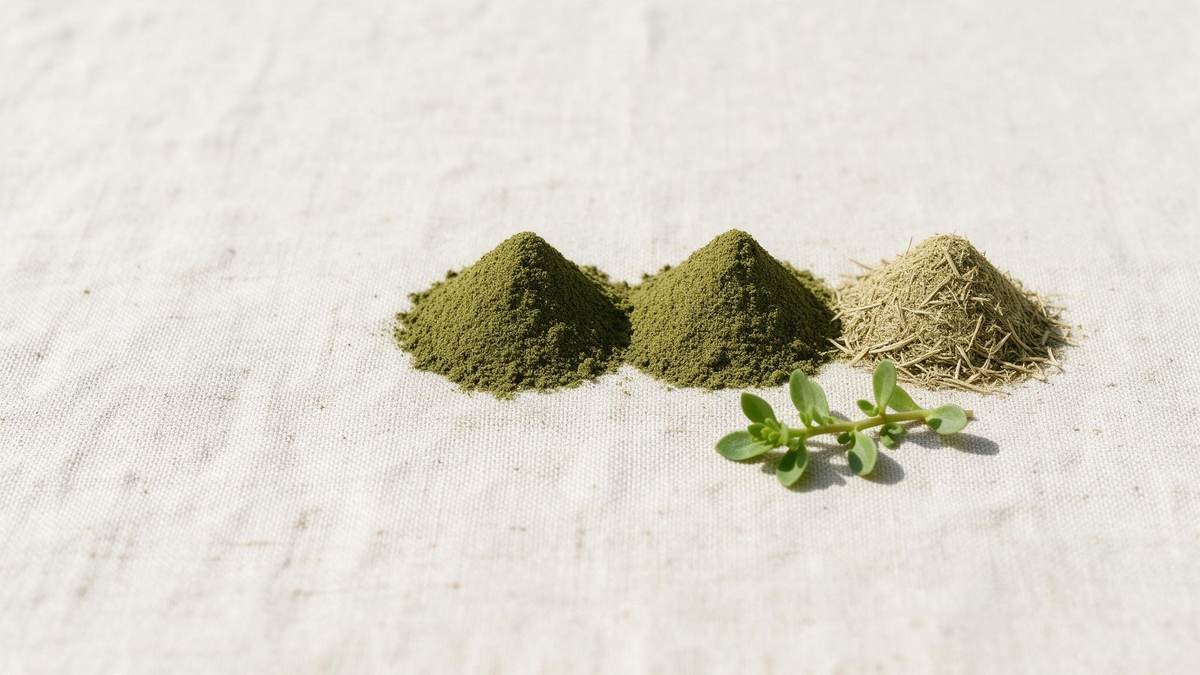 Does this herb work for memory?A twelve-week wait for whatWatch the video on why one word on a supplement label carries so much weight
If you recognize yourself here, watch the full video about the wider pattern these moments belong to.
One bottle whose fine print you now read correctly is a single moment; the same standardization promise waiting on every shelf is a pattern you will face again, so go back with that in mind, watch the full video before the next label asks you to trust it.
Everything on Supplements & food →
▶ Watch the memory video