A friend leaning over the back of the couch points at the word mycelium before you have read it yourself, then asks why grain is printed on a mushroom pill at all. You had been watching the milligram number, the largest print on the front of the bottle, and treating it as the answer to how much you would get. So how much of that weight is really lion’s mane, and does it line up with anything that was studied?
You are standing in the supplement aisle, holding a bottle that says lion’s mane on the front, and the back label is a wall of small print. The word mycelium appears once, fruiting body appears once, and the number of milligrams is printed larger than anything else, but none of it tells you what you actually want to know. The tension is simple: you want a dose that matches what was studied, and the label is giving you a part of the mushroom and a form that may not match anything in the research. The useful answer straight away is that good evidence on lion’s mane mushroom supplements is limited, and the label details that matter most are the part used, the extract ratio, any beta-glucan claim, and whether grain filler is listed. No established upper limit exists, so ‘too much’ is not a number you will find on a bottle.
What the label tells you about the part used
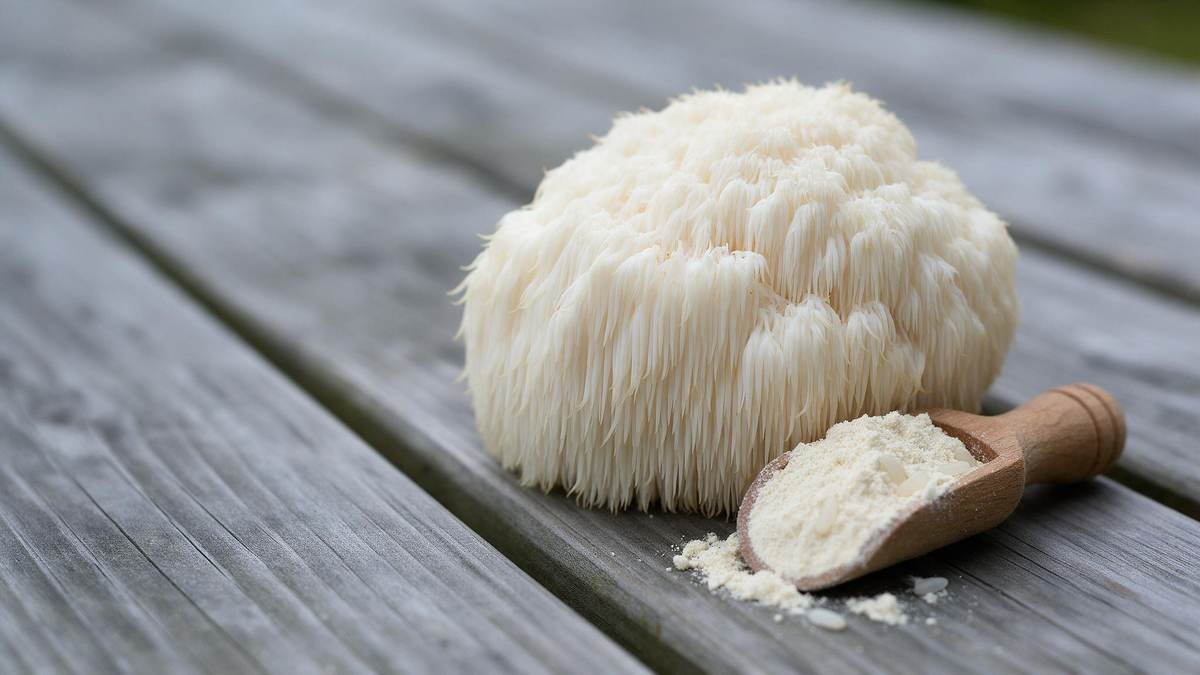
A lion’s mane supplement label will usually name either the fruiting body or the mycelium, and sometimes both. The fruiting body is the visible mushroom, the part that grows above the substrate. The mycelium is the root-like network that grows through the substrate, and in commercial production that substrate is often grain. A label that lists mycelium without saying how much grain remains is not telling you the full story.
The distinction matters because the two parts are not interchangeable in terms of what they contain. If the label does not state the part used clearly, you are reading a label that has already failed the first test.
Extract ratio and why it changes the dose
An extract ratio such as 8:1 or 10:1 tells you how much raw material was used to make a given amount of extract. An 8:1 extract means eight parts of mushroom were reduced to one part of extract. This does not automatically mean the extract is eight times stronger, because the ratio says nothing about which compounds survived the process.
Reading the label part by part
| Label says | What it tells you | What it leaves out |
|---|---|---|
| Fruiting body | The visible mushroom above the substrate | Whether beta-glucans were measured |
| Mycelium | Root-like network grown through grain | How much grain remains in the capsule |
| Extract ratio such as 8:1 | Raw material reduced to one part extract | Which compounds survived the process |
| Beta-glucan percentage | A quality marker stated on the label | Whether humans were tested at that dose |
The problem is that extract ratios are not standardized across products, and a higher ratio is not always better. Without a stated beta-glucan content, the ratio is a number without a reference point. A label that gives an extract ratio but no beta-glucan percentage is giving you half a measurement.
Beta-glucan claims and what they do not prove
Beta-glucans are polysaccharides found in mushroom cell walls, and they are often cited as the active component of interest. A label may state a percentage of beta-glucans, and that is more useful than a ratio alone, but it still does not tell you whether the product has been tested in humans at that dose.
A beta-glucan claim is a quality marker, not an outcome marker. The presence of beta-glucans does not mean the supplement will do what you hope it will do, because the trials that would establish that are not available in the evidence base for this page.
Grain filler and why it appears on the label
Some labels list grain as an ingredient, and some do not, but the presence of grain filler means the actual mushroom content is lower than the total weight suggests.
Six checks on the front and back
- Part used is named as fruiting body or mycelium
- Extract ratio is stated, such as 8:1 or 10:1
- Beta-glucan content is given as a percentage
- Grain filler is listed separately from mushroom weight
- No disease claim appears on the label
- The label does not imply a safe upper limit
A label that lists brown rice or oats among the ingredients is telling you that some of the capsule weight is not mushroom at all. This is not necessarily a safety problem, but it is a dose problem, because the milligram amount on the front of the bottle may include the filler. If the label does not separate mushroom weight from filler weight, you cannot know how much lion’s mane you are actually taking.
Trial doses, typical capsule doses, and the gap between them
The public health guidance and published research for this page do not cover lion’s mane mushroom supplements, so no trial dose, no year, no participant count, and no percentage can be given here. Good evidence on lion’s mane is limited, and what would be needed to know more is a set of human trials that report the part used, the extract ratio, the beta-glucan content, and the actual dose of mushroom material delivered.
A typical capsule dose on a label is often in the range of a few hundred milligrams to a gram or more per serving, but without trial data there is no studied dose to compare it against. The gap between what a label offers and what research supports cannot be closed by reading the label more carefully.
Upper limits are not established, so the question of how much lion’s mane is too much has no evidence-based answer. The signals that matter are not numbers on a label but physical reactions. If you develop a rash or breathing problems after taking a lion’s mane supplement, stop taking it and see a doctor. A persistent or worsening change in memory or thinking should also be discussed with a doctor, because memory trouble has several possible causes and no single supplement addresses them all.
Reading the label as a checklist
Part used is named as fruiting body or mycelium, not just lion’s mane.
If your body reacts
- If a rash appears after taking it, stop taking it and see a doctor
- If breathing problems appear after taking it, stop and see a doctor
- If a memory or thinking change persists or worsens, discuss it with a doctor
Extract ratio is stated, such as 8:1 or 10:1, rather than omitted.
Beta-glucan content is given as a percentage, not left to inference.
Grain filler is listed separately if mycelium is used, so mushroom weight is clear.
No disease claim appears on the label, because no such claim is supported.
The label does not imply a safe upper limit, because none is established.
 Is your lion’s mane mostly rice?The label says lion’s mane, butThis video walks through the one part of a lion’s mane label most people skip, and why it changes what you think you are taking.
If you recognize yourself here, watch the full video about the wider pattern these moments belong to.
A single missed line on one bottle is a small slip, and it is usually the small version of a pattern that keeps returning every time a label does the deciding for you, so watch the full video to follow it further.
Everything on Supplements & food →
▶ Watch the memory video