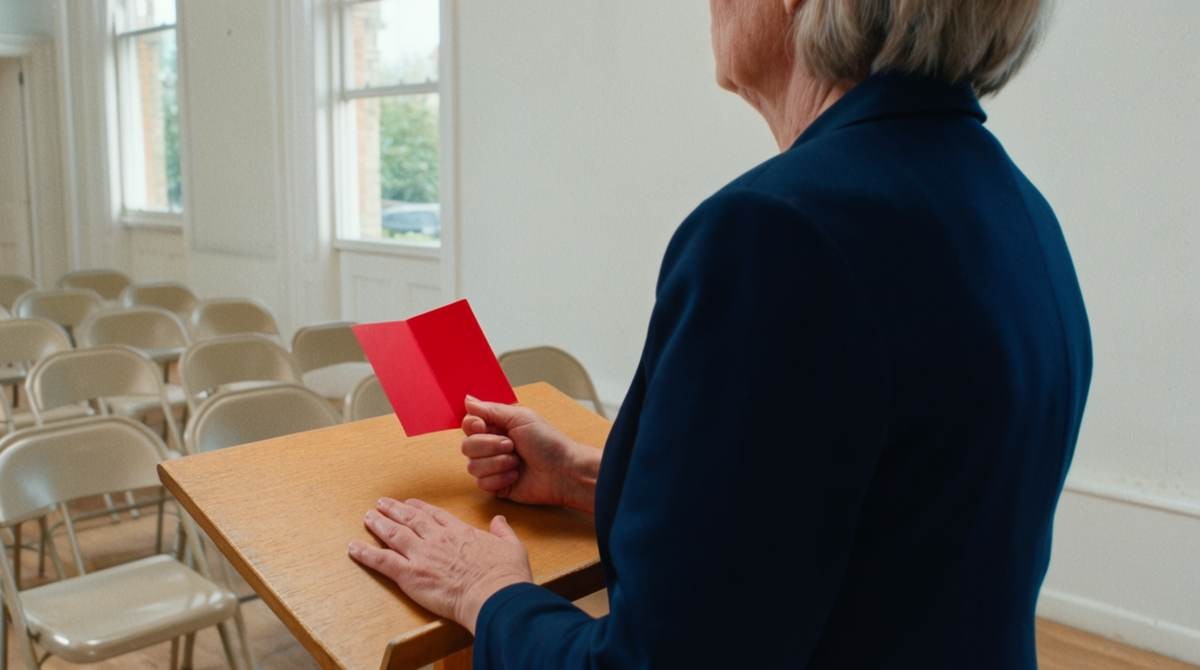
You have already crossed the room and reached the lectern, the card you wrote out at the dining table folded small in your hand. The water is warm, the room is quiet, and the first sentence you planned simply is not there. What has to happen now, before the pause becomes the thing everyone remembers?
 The real reason you sound scriptedWhat to do when the line disappearsWatch the video and see how a speaker finds the next line while the room waits
The microphone is heavier than it looked from the back of the room. You have the card in one hand, the water glass has gone warm against the lectern, and the first sentence you wrote three days ago is simply not there. What arrives instead is a sentence you have never said, half of a joke, and then a silence that feels far longer than it is. Nobody in the room knows you lost the line. You know it, and you know it in your hands. Here is the practical answer. Memorize the structure, not every word. Rehearse the opening line and the closing line until they come out without thinking, and hold the three to five anchors between them as single ideas you can talk around in your own words. The middle of a speech is allowed to be different each time you say it. That is not a shortcut around the work. It is the part of the work that survives pressure, because a structure is far easier to carry than a page of exact sentences. We should say plainly, early, that good human trials on memorizing a speech fast are scarce, and published guidance gives no dose, no fixed number of repetitions, no set amount of rehearsal time. A useful study would have to compare people who learned a structure against people who learned a script word for word, measure how much of the content each could actually deliver under time pressure, and check whether listeners heard one group as more recited than the other. Until something like that exists, what follows is craft rather than clinical finding.
Memorize the spine, not the script
A speech has a spine: the order of its ideas, and the reason each one follows the last. Learn that order first and the words become negotiable. You can say the same anchor in three different sentences on three different nights, and the audience will never know, because they are following your meaning, not your phrasing. What they notice is hesitation, and hesitation comes from trying to retrieve a sentence rather than a thought. Start by reading your draft aloud once, then close it and say the shape of it in plain speech. Where you stumble, the shape is wrong, not your memory. Fix the order before you fix the wording.
Write the order on a single card and keep the card where you can see it while you rehearse, until the order stops needing it. You are training the sequence, not the prose.
The cost lands in the moment you had one chance. A toast you agreed to give because you were the only one who knew the story, and halfway through the room is watching you recover. Afterwards you start declining, a eulogy passed to someone else, a work talk taken off your name, a wedding speech written down and read flatly from a page so nothing can go missing. You volunteer less. You learn shorter lines. What you give up is not the ability to speak, it is the willingness to be the one who speaks without a script in hand.
Why a word-for-word speech collapses on stage
Verbatim memorization builds one long chain. Each line hangs off the one before it, so a single break at the start stops everything after it. Under ordinary conditions you never notice the chain, because you are calm and the room is quiet and the lighting is flat. On the night itself, adrenaline, faces, a cough, a glass being set down, any of them can break a link, and you are left holding a sentence that will not come. There is a second cost. Word-perfect recall and natural delivery draw on the same attention. When you are spending it on matching an exact phrasing, you have less left for eye contact, for pace, for the pause that lets a good line land. Listeners rarely complain that a speaker used different words than planned. They complain that the speaker seemed to be reading.
Reciting also flattens the ending, which is the part people quote afterward. A closing line rehearsed to muscle memory and delivered to the room sounds decided rather than remembered, which is exactly what a toast or a eulogy needs.
The one-card outline
The card holds four things and nothing else. The opening line, written out exactly as you will say it. Three to five anchors, one word or short phrase each, in the order you will speak them. The closing line, written out exactly. Turn the card over and write nothing on the back, because a card you have to search is a card that has already failed you. Keep the anchors concrete and specific to you. A name, an image, a place, a number you care about. Vague anchors like point two or the story will not hold under pressure, because they require a second lookup. An anchor should put the whole passage back in your mind the moment you see it. Carry the card but do not read from it. In rehearsal, hold it face down and use it only to check yourself afterward. The goal is to glance once, at most, and to glance at a card that tells you where you are rather than what to say.
If the lapses have started appearing outside speeches as well, in ordinary days and ordinary rooms, this is a reasonable place to pause with us and watch the full video.
Three days out, one day out, one hour out
Three days before: write the card, then read the speech aloud twice with it in hand. Say the opening and closing lines out loud several times each, standing up, at the volume you will use in the room. Sleep between sessions if you can, since spaced practice across days beats one long session that leaves the words mushy. One day before: put the card down and deliver the whole speech from memory, out loud, once. Note only the places where you stalled, then fix those anchors. Do not rewrite the speech at this point. Rewriting on the final day gives you new sentences you have never said aloud, which is the worst possible thing to be relying on. One hour before: say the opening line once and the closing line once, quietly, then stop. Check that the card is in the pocket you will reach for. Then let it rest, because the last thing you want is a half-recited version stuck in your head when you walk up.
Rehearsal timeline
- Three days before: write the card, read the speech aloud twice with it in hand
- Say the opening and closing lines out loud, standing, at room volume
- One day before: put the card down and deliver the whole speech from memory once
- Note only where you stalled, then fix those anchors and do not rewrite
- One hour before: say the opening and closing lines quietly, then stop
Which parts deserve to be rehearsed word for word?
Rehearse to muscle memory the opening line and the closing line, plus anything that must be exact: a quotation you did not write, a person’s name and title, the formula of a toast. These are the moments where a stumble is visible to everyone and where improvising would cost you something. The opening matters most, because it sets the room’s expectation of you within the first few seconds, and the closing matters because it is what people carry out with them. Everything between belongs to the anchors. Give yourself permission there to use the words you would use in conversation, since that is what makes a talk sound like a person speaking rather than a page being recited. The National Institute on Aging puts it simply: memory does not always work perfectly, and forgetting things once in a while is normal. A speech is an unusual load to put on it, and the structure is how you make the load reasonable.
What the card holds
- The opening line, written exactly as you will say it
- Three to five anchors, one word or short phrase each
- The closing line, written out exactly
- Nothing on the back, because a card you must search has failed you
- Anchors that are a name, an image, a place, or a number you care about
Behind every slip that keeps returning sits a larger question this page does not settle: what actually determines whether recall holds when the pressure arrives, and why the same preparation is enough for one person on one night and not for another. Structure and rehearsal answer part of it. Whether the failing is in the encoding, in retrieval under stress, or somewhere else in the week that preceded the room is a different matter, and we are deliberately leaving it open.
What to do when the next line does not come
Blanking in front of a room is common, and it happens to people who prepared well. The reliable move is small: stop, take one breath, look at the card, and say the next anchor aloud in a full sentence rather than trying to recover the exact one you had planned. Keep your voice at the same volume as before. The pause will read as thought, not as failure, and the audience will follow you back in. Do not apologize for the gap. An apology names the problem out loud and hands the room something to feel sorry about, and it is harder to recover once you have done it. One anchor usually restarts the chain, and the rest comes back in order. If the difficulty stops being about speeches and starts showing up in ordinary days, in finding words, in following a recipe you have used for years, that is a different situation. Memory trouble has several causes and not one, so a change that persists or gets worse belongs with your doctor.
When the line goes missing
- If you stall, take one breath and look at the card
- If the place is gone, say the next anchor aloud in a full sentence
- If the gap stretches, keep your voice at the same volume as before
- If you feel the urge to say sorry, do not apologize for the gap
For anyone whose recall has become less reliable across the whole week rather than at a lectern, the fuller conversation is here: watch the full video.
Everything on Memory training →
▶ Watch the memory video