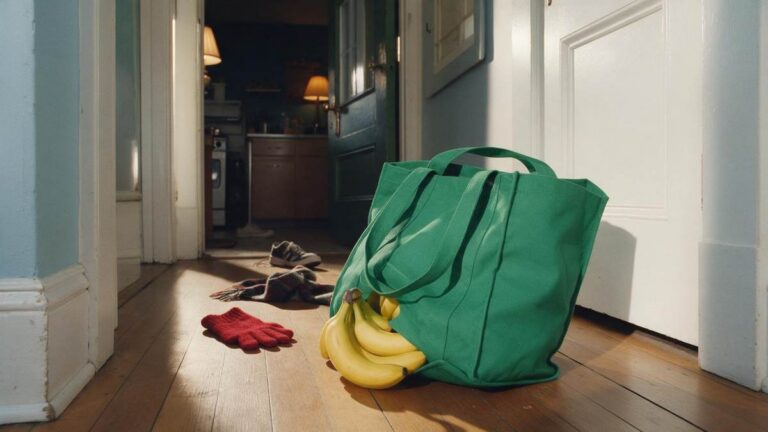
The pen hovers over the notebook page where you meant to write one name, and the name will not come. You have been carrying this week’s load for weeks now, and the notes app on your phone stays open all day. Is the forgetting the pressure itself, or something else riding alongside it?
 The name won’t come? There’s a patternWhich part is the stress?Watch the video on a quiet evening if your own lines still leave you unsure
You are mid-sentence when the name stops. It belongs to someone you have worked beside for years, and the syllables are simply not there, so you keep talking around it and hope nobody counts the gap. Later you are standing in the kitchen holding your phone, thumb hovering over a message you have already sent twice to the wrong thread. The groceries sit on the counter in a neat list you wrote this morning and no longer trust. Stress-related memory lapses usually ease as the load comes down. You can act on that inside one ordinary week: cut the pressure where you can, write down what slips and what holds, then watch which way it moves over a few more weeks. One caveat first, because it is the honest starting point. Good human trials on reversing stress-related lapses are scarce, and published guidance gives no dose, no set program, and no timeline anyone can be held to. What follows is how to watch your own case carefully, and exactly when to hand it to a doctor.
What a stressed week does to remembering
Stress is how your brain and body answer a demand. The hormones released in that moment make you alert and ready to act, raising blood pressure, heart rate, and blood sugar so you can move quickly. A short burst is useful: the deadline that gets you moving, the car that makes you brake. When it runs for weeks or months, the body behaves as though the threat is still present, and attention stays welded to whatever is pressing hardest. Names, errands, and the sentence you were halfway through are not pressing.
Which way the lines point
- If recall improves as the load comes down, keep going and add another week to the log
- If it is not improving after life has calmed down, make an appointment and bring the log
- If it gets worse at any point, make an appointment now rather than waiting for more lines
- If confusion arrives suddenly or behavior changes markedly, seek prompt care instead of another week of observation
Interrupted sleep is the other half of it. Adults generally need seven to nine hours a night, and sleep is when new material is settled into memory. Frequently interrupted sleep means missing whole stages of it.
Then the confounders that arrive with any hard season: hearing or vision loss, medicines whose side effects include confusion or memory changes, low mood, uncontrolled blood pressure or diabetes, alcohol. NIMH notes that severe stress symptoms lasting two weeks or more, including difficulty focusing and losing interest in usual activities, are worth a provider’s attention. The causes of memory trouble are several, never one.
By the third week you have rewritten the same list four times, and the list itself has become the point of the evening. You start writing things down before you leave the room, then during the conversation, then under the table while someone is still talking. You stop volunteering to give the update. You let the phone ring and text instead, stop calling back the friend who leaves long messages, skip the dinner where you would have to introduce two people you have already met once. The notes app stays open. The reading at night quietly ends.
Does anyone actually know this works?
Good human trials on this specific question are scarce, and we would rather say so early than dress up an absence. A useful study would have to enroll people whose stress has genuinely dropped, measure their recall while the load was high and again after it fell, follow a comparison group whose load did not fall, and keep going long enough to tell a real recovery apart from a couple of good weeks. That study is not what the published guidance offers.
What exists instead is general advice on maintaining cognitive health: keep sleep regular, stay physically active, manage chronic conditions, review medicines with a doctor, treat hearing and vision loss, stay engaged with people. Federal guidance puts adult activity at about 150 minutes a week and says walking is a reasonable start. These are the background conditions for thinking clearly, not a promised reversal of anything.
We keep returning to this point: an absence of trials is not proof that nothing happens when the pressure lifts. It means nobody has measured it well enough to tell you how reliably it happens, or for whom.
We left a longer version of this reasoning in the video drawer, and you can watch the full video on a quiet evening if the log still leaves you unsure.
How do you tell whether it is easing?
Memory during a hard stretch is a poor witness, because you remember the mornings that went badly and forget the ones that did not. A log fixes that by being dull and daily. Keep five fields and fill them at the same time each night. Day: what you were meant to remember and whether it arrived. Sleep: roughly how many hours, and whether you woke. Load: what is still pressing. Holds: one thing you recalled without help. Slips: one thing you did not.
Five fields for the nightly log
- Day: what you were meant to remember and whether it arrived
- Sleep: roughly how many hours, and whether you woke
- Load: what is still pressing
- Holds: one thing you recalled without help
- Slips: one thing you did not
- Fill the fields at the same time each night, without scoring or comparing
Do not score it, grade it, or compare it with anyone else’s week. Two or three weeks of lines beat one bad morning, and they also give a doctor something concrete to read instead of your anxiety about the whole thing.
The fork
The decision depends on one variable: which direction the lines point once the pressure has actually lifted. Improving as the load comes down: keep going with what you are doing and add another week to the log. Not improving after life has calmed down: make an appointment and bring the log with you. Getting worse at any point: make an appointment now rather than waiting for more lines to accumulate.
A doctor will read the log alongside the rest of it: sleep, mood, hearing, blood pressure, and every medicine you take, including over-the-counter ones. Screening tests are screening, never a diagnosis, and they are only one input. If a change persists or keeps worsening across weeks, that persistence itself is worth a visit, with or without a full log.
Underneath each slip sits a question this page deliberately leaves open: which part of your forgetting belongs to the stress, which belongs to sleep, mood, medicines, hearing, or an untreated condition, and why one person’s recall bounces back when the load drops while another person’s does not. Sorting one hard month from the rest of a life is not something a single week of notes can settle.
Which changes should not wait for the log?
Sudden confusion, getting lost in a place you know well, and a marked change in personality or behavior are different in kind from a name taking an extra second. They need prompt care, not another week of observation. Confusion that appears abruptly, especially during illness or after a hospital stay, is an emergency situation rather than a note for the log: call 911.
What the missing trials mean
- Myth: no trials means nothing happens when pressure lifts
- Fact: nobody has measured it well enough to say how reliably it happens
- Fact: general advice covers sleep, activity, medicines, hearing, vision, and mood
- Fact: screening tests are screening, never a diagnosis
The log has no jurisdiction over a sudden change, and it is not a reason to postpone one. For anything that arrives gradually but persists or worsens, route it to a doctor and say plainly when it started, what has changed, and what you have already tried.
When the log says life has calmed down and your recall still has not, another explanation deserves a proper hearing before you settle on one. watch the full video before you decide what your own lines mean.
▶ Watch the memory video